Description. Small ammonites with an evolute phragmocone and a slightly depressed to moderately compressed section. The ribs are variable. They may originate from the umbilicus and traverse the flank and venter, to stop at the ventrolateral shoulder of the opposite flank. Others divide at the top of the flanks and connect in a zigzag or loop with one or two bifurcated ribs on the opposite flank. They may even be simple and annular, which is often the case for the last ribs on the body chamber. Tubercles relatively weak or even absent, often reduced to a simple angulation of the ribs in a siphonal and ventrolateral position in depressed variants. The suture is simple, with rounded, slightly incised bifid saddles, and smaller, narrower lobes. Type species Ammonites versicostatus Michelin, 1838. Genus from the base of Middle Albian (benettianus zone, lyelli subzone): Aube, Yonne, Alpes Maritimes (Clars, Escragnolles, Gourdon).
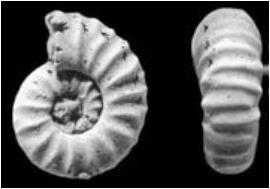
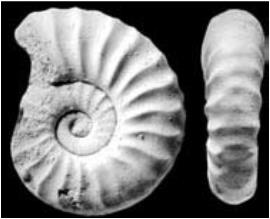
Species. This genus has only two species currently. The type species, Pseudobrancoceras versicostatum (Michelin, 1838) (top image from Kennedy, 2004), possesses the variable ventral ribbing characteristic of the genus, hence its name. It is very small: known specimens have a maximum diameter of 26 mm. The depressed to compressed whorls overlap by half; the umbilicus is wide with an O/D ratio of 33 to 40%; the 24–32 ribs counted on venter have tubercles visible only on a minority of the specimens illustrated by Kennedy. Pseudobrancoceras transiens Kennedy, 2004 (bottom photo from Kennedy again) is barely larger, since it reaches 32 mm. It also has a wide umbilicus (O/D ratio of 34–38%), but it is always more or less compressed, with fewer ribs on the venter (21–25). These ribs bear small ventrolateral and siphonal tubercles (the latter visible on the photo), with a venter that is often somewhat fastigiate (folded like a roof) in costal section. Generally, the siphonal tubercles are more numerous than the others, resulting in zigzag or looped ventral connections.
Remarks. Kennedy established this genus after examining numerous specimens of Ammonites versicostatus Michelin, 1838, which had been classified by some authors as Brancoceras or Lyelliceras. For him, they are contemporary homeomorphs of Brancoceras and likely descendants of Lyelliceras. In particular, P. transiens would descend from Lyelliceras pseudolyelli, which also has zigzag ribs on its venter but reaches a larger size (80 mm), with lateral and umbilical tubercles. It represents a transitional form towards P. versicostatum, which is less compressed and has weak or absent tubercles.