| Measurements | D mm | H/D | T/D | O/D | H/T |
|---|---|---|---|---|---|
| Lectotype | 88.5 | 0.47 | 0.32 | 0.25 | 1.47 |
| CP-468* | ? | H = 49.3 | E = 34.3 | ? | 1.44 |
| Age | Origine |
|---|---|
|
Grey clay, lyelli subzone benettianus zone Middle Albian |
Meuse France |
| Measurements | D mm | H/D | T/D | O/D | H/T |
|---|---|---|---|---|---|
| Lectotype | 88.5 | 0.47 | 0.32 | 0.25 | 1.47 |
| CP-468* | ? | H = 49.3 | E = 34.3 | ? | 1.44 |
| Age | Origine |
|---|---|
|
Grey clay, lyelli subzone benettianus zone Middle Albian |
Meuse France |
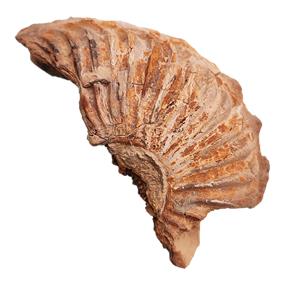
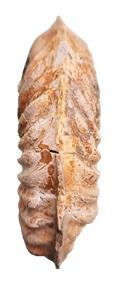
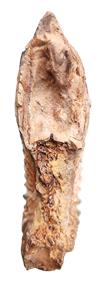
Description. A third of whorl in limestone belonging to a body chamber, with a chipped siphonal keel and 17 simple ribs with wider interspaces. The gently sloping umbilicus is continuous with the flank. The whorl section is initially elliptical, somewhat compressed, truncated by a flattened venter with distinct shoulders. The first four complete ribs, almost straight, originate thin and sharp at the umbilical suture. They rise and widen up to the ventral shoulders, where their cross-section shows a steep, slightly concave anterior slope, a rounded crest, and a less steep, convex posterior slope. They then flatten out near the keel. The following ribs become thin, more flexuous, and strongly projected forward. At the same time, the whorl section narrows and the venter pinches, with less distinct shoulders.
Remarks. Personal discovery. The last ribs are those of Oxytropidoceras (Oxytropidoceras) roissyanum, but the first ones recall Oxytropidoceras (Mirapelia) mirapelianum. However, the other flank has only thin ribs projecting forward, and mirapelianum has even wider ribs, flatter at the top of the flanks, with narrow intercostal spaces (see its entry). We therefore assign this specimen to O. (O.) roissyanum, especially since the lectotype in the Révision critique de la Paléontologie française (Fischer, 2006, pl. 42, fig. 1a-d) displays the same rib peculiarity, with ribs broadened at the end of last whorl on one of the flanks. Spath (1931) already noted different ribs on the two flanks in certain Oxytropidoceras. This uncommon species does not appear to have been revised since d'Orbigny, and its range of variation is unknown. Well-preserved specimens have been found in condensed levels in southeastern France (Escragnolles), but the Paris Basin yields only small pyritic nuclei and body chambers in limestone.