Description. According to Wright (1996), this cosmopolitan, more or less compressed genus has tall whorls and a high siphonal keel. The ribs are narrow and tall, rounded or flattened, with or without tubercles. The keel may appear before the ribs, and the ribs may disappear with age. The suture generally has an oblique external slope on the main saddle, resulting in a ventral lobe shaped like a downward-pointing triangle. Type species Ammonites roissyanus d'Orbigny, 1841. This genus is found throughout the Albian: Europe, Africa (South Africa, Angola, Madagascar, Morocco), USA (California, Texas), Latin America (Brazil, Colombia, Mexico, Peru, Venezuela), and Pakistan.
Subgenera. Oxytropidoceras sensu stricto has compressed whorls of varying height and ribs without tubercles, ranging from fine to strong, tall and narrow to flat, often bifurcated. Lower and Middle Albian. Mirapelia Cooper, 1982, is somewhat compressed, with ribs also lacking tubercles, ranging from strong to rather fine, less frequently bifurcated, flattened and broadened on the ventral shoulders. Middle Albian. Venezoliceras Spath, 1925, has a compressed rectangular section, with ribs bearing sometimes an umbilical to lateral bulla, and always a ventrolateral bulla or clavus. Middle and Upper Albian. Manuaniceras Spath, 1925, has numerous flat ribs, with a low parallelepiped whorl section and very narrow intervals. Considered a synonym of Oxytropidoceras by Cooper (1982) and Wright (1996), it is maintained by Kennedy & Klinger (2011).
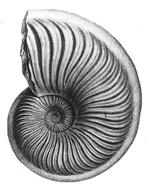
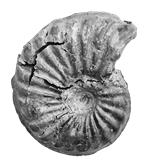
A few species. O. (Oxytropidoceras) roissyanum (d'Orbigny, 1841, top figure) has a lanceolate section with a high keel. Its sigmoid ribs are strongly projected forward at the top of the flanks and many bifurcate at the umbilical margin. O. (O.) alticarinatum (Spath, 1922) has fewer ribs (25 per whorl), less frequently bifurcated. Its cross-section resembles a teardrop, with a very high keel. O. (O.) cantianum Spath, 1931, has numerous ribs (70 per whorl), somewhat biconcave, with a flattened crest. O. (Mirapelia) mirapelianum (d'Orbigny, 1850) has undivided, less flexuous ribs that flatten and widen at the top of the flanks, with a steeper anterior slope than posterior slope (bottom photograph). Several species also exist in South America; see Knechtel (1947), Benavides-Cáceres (1956), and Robert (2002).
Remarks. A rare genus in Aube, reported from the steinmanni zone to the base of the intermedius zone (Amédro et al., 2014).