| Measurements | D mm | H/D | T/D | O/D | H/T |
|---|---|---|---|---|---|
| CP-130 | 20.3 | 0.43 | 0.36 | 0.26 | 1.19 |
| CP-721 | 106 | 0.51 | 0.36 | 0.23 | 1.42 |
| Age | Origin |
|---|---|
|
Pariatambo Formation Peruvian ulrichi zone Beginning of Middle Albian |
Baños del Inca Cajamarca Region Peru |
| Measurements | D mm | H/D | T/D | O/D | H/T |
|---|---|---|---|---|---|
| CP-130 | 20.3 | 0.43 | 0.36 | 0.26 | 1.19 |
| CP-721 | 106 | 0.51 | 0.36 | 0.23 | 1.42 |
| Age | Origin |
|---|---|
|
Pariatambo Formation Peruvian ulrichi zone Beginning of Middle Albian |
Baños del Inca Cajamarca Region Peru |
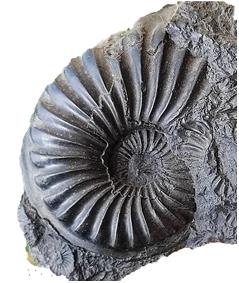
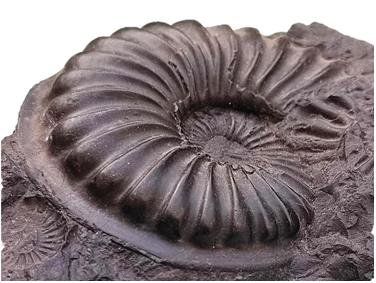
Description. A beautiful ammonite in a block of black shale, with one side prepared and test remains in the umbilicus, without visible sutures. The compressed elliptical whorls overlap by half. They bear a high, pinched, smooth, and sharp ventral keel, missing on the last quarter of whorl. The venter is somewhat flattened if the keel is disregarded. The 50° umbilical wall rounds towards the flank without a distinct shoulder. On the last whorl, 28 simple, regularly spaced ribs arise, thin and sharp, from the umbilical suture. Slightly proverse on the umbilical wall, they straighten on the flanks to terminate on the venter, leaving a smooth, narrow band along the keel. On the flanks, the ribs are slightly rursiradiate, with a straight or barely sigmoid ridge line. They gradually widen and thicken towards venter, with a concave anterior slope and a less pronounced, convex posterior slope. The rounded ventral terminations are particularly broad.
Remarks. A specimen very similar to the MNHN-5758 in the d'Orbigny collection, coming from Clars (Var) and illustrated by Cooper (1982, p. 287, fig. 14D-E). According to Robert (2002), this species, known in southeastern France, is uncommon in Peru, where it has only been discovered at Baños del Inca and Yanarajo. Three Peruvian Oxytropidoceras are more widespread in the black shales of the Pariatambo Formation. O. (Mirapelia) douglasi Knechtel, 1947, has more convex flanks, without ventral shoulders, a steeper umbilical wall, and more flexuous ribs with less broadened ends (see its entry). O. (Manuaniceras) carbonarium (Gabb, 1877) has numerous fine, close, and flattened ribs. It defines the Peruvian ammonite zone that follows the ulrichi zone. O. (O.) peruvianum (von Buch, 1839) has an almond-shaped whorl section, with more convergent flanks and a narrower venter, and fine sigmoid ribs with slightly wider intercostal spaces.