| Measurements | D mm | H/D | T/D | O/D | H/T |
|---|---|---|---|---|---|
| Collignon 1963 | 26 | 0.27 | 0.23 | 0.42 | 1.17 |
| CP-57 | 29.5 | 0.31 | 0.28 | 0.42 | 1.16 |
| Age | Origin |
|---|---|
|
A. besairiei Malagasy zone Lower Albian |
Ambatolafia Boeny Region Madagascar |
| Measurements | D mm | H/D | T/D | O/D | H/T |
|---|---|---|---|---|---|
| Collignon 1963 | 26 | 0.27 | 0.23 | 0.42 | 1.17 |
| CP-57 | 29.5 | 0.31 | 0.28 | 0.42 | 1.16 |
| Age | Origin |
|---|---|
|
A. besairiei Malagasy zone Lower Albian |
Ambatolafia Boeny Region Madagascar |
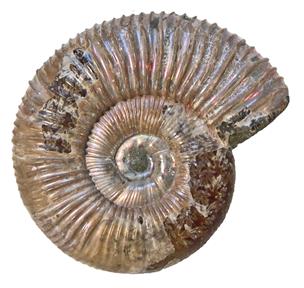
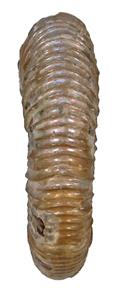
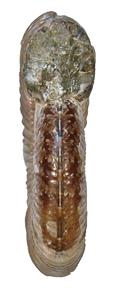
Description. A small, flat, entirely septate ammonite with a nearly complete pearly test, showing only fragments of the suture line. The whorls overlap very little, and the wide umbilicus has a very low wall. The flanks are parallel and barely convex, the venter broadly rounded, and the whorl section slightly higher than wide. The flanks are initially smooth, then the ribs appear after a constriction at 4 o'clock on the penultimate whorl. They are sharp, thin, and closely spaced, slightly convex on the flanks. They bifurcate in the outer quarter of the flanks, curving slightly forward, and then cross venter, where about one hundred can be counted. The point of dichotomy of the ribs is sometimes absent, resulting in a few intercalated simple ribs. Constrictions are irregularly distributed, initially distinct, as at 7 o'clock on the penultimate whorl, then reducing to slightly wider intercostal spaces. The ribs tend to become radial and more distant on the last quarter of whorl.
Remarks. This species, discovered in the Sinai peninsula (Egypt), has also been reported in Tunisia and Madagascar. It is always small, not exceeding 3 cm in diameter. Our specimen is entirely consistent with Douvillé's holotype shown on our page for the genus Neosilesites, except that it is slightly thicker. Collignon (1963, p. 107) illustrates a Malagasy specimen and defines a very similar species, N. ambatolafiensis, which differs only in a higher whorl section (H/E ≥ 1.30) and ribs that project further forward near the venter.