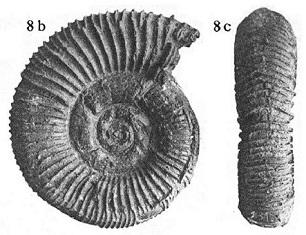
Description. Neosilesites has flat or convex flanks, a broadly rounded venter, and close, sharp primary ribs that bifurcate at the top of the flanks to form secondary ribs that cross the venter. The constrictions are weaker than in Silesites and correspond to wider intercostal spaces than in other species. This genus was separated from Silesites by Breistroffer to distinguish forms with ribs bifurcating near venter.
Age and distribution. Neosilesites is a Tethyan genus found from the Late Aptian to the Early Albian in the Balearic Islands, Austria, Tunisia, Egypt (Sinai), and Madagascar. Silesites, that can be found in France, is limited to the Barremian. Neoastieria is known only from the Late Aptian of Caucasus, and Miyakoceras from the Late Aptian of Japan.
Species. Five species of Neosilesites are known: N. nepos H. Douvillé, 1917 (initially classified among the Silesites); N. ambatolafiensis Collignon, 1963; N. ampakabensis Collignon, 1963; N. madagascariensis Collignon, 1963; and N. maximus Collignon, 1963. The last four are illustrated in fascicle X (Albian) of Collignon's Atlas of Characteristic Fossils of Madagascar, but in our opinion, N. ampakabensis and N. madagascariensis fall within the range of variation of N. nepos. These ammonites are generally very small: 2 to 3 cm in diameter, except for N. maximus which can reach 6 cm, hence its name.