Created 19/11/2023
Updated 2024/03/11
Neodeshayesites stutzeri (Riedel, 1938)
| Measurements |
D mm | H/D | E/D | O/D | H/E |
|---|
| RGM 291 878* |
44.5 | 0.47 | 0.39 | 0.27 | 1.22 |
| CP-311 |
47.3 | 0.42 | 0.32 | 0.29 | 1.29 |
| CP-636 |
74.8 | 0.42 | 0.31 | 0.26 | 1.35 |
| RGM 291 871* |
81.2 | 0.47 | 0.33 | 0.23 | 1.42 |
* Specimens in Bogdanova & Hoedemaeker (2004)
| Age |
Origin |
|---|
Black shale
Capotes Member
Lower Albian
|
Banks of Rio Bogotá
Apulo, dept of Cundinamarca
Colombia
|
Description.
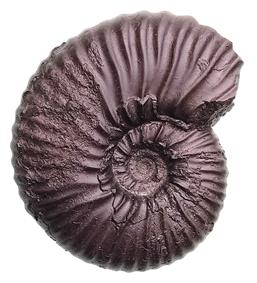
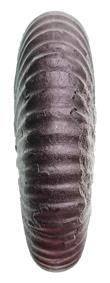
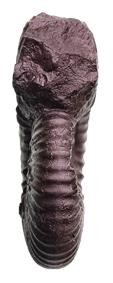
Internal mold in black shale, without visible sutures, with test remnants near the umbilicus. The last quarter of whorl has an eccentric tendency and overlaps the previous whorl by 40% at the end. The compressed elliptical section has its maximum thickness slightly above the umbilical margin. The broad, rounded venter, chipped near the aperture, is somewhat flattened at the beginning of last whorl. It transitions to the flanks without noticeable shoulders.
The umbilicus has a quarter-circle slope between the ribs. Primary ribs originate at the umbilical suture, with a triangular cross-section and a sharp crest. They are flexed backward on the umbilical wall, curved forward and raised at the margin, then sigmoid on the flanks where some bifurcate. They gradually lower and widen toward venter, and their crest becomes rounded. The last ribs are slightly biconcave. These primary ribs alternate irregularly with secondary ribs of varying lengths, originating at mid-flank or lower. The venter shows a total of 45 closely spaced, well-rounded ribs of similar appearance. They cross the venter initially in a straight line, with a weak convex sinus at the end of the whorl.
Remarks.
Bogdanova & Hoedemaeker (2004) state that their Colombian specimens are thicker than those of Riedel. The latter illustrates three without dimensions (pl. 7, figs. 5-9), and I computed a T/D ratio of 0.29 for the specimen in his figs. 5-6. Our specimens are therefore intermediate, but all these ammonites have the same typical ribbing in profile view; see plates 7 and 8 of Bogdanova & Hoedemaeker. Similar-looking Parahoplites exist in the Aptian black shales of Colombia, for example, P. maximus Sinzow, 1907 (Sharikadze et al., 2004). They are thicker, with a wider venter, a more pronounced ventral sinus, and higher and fewer ribs (at most 40). Although our ammonite has no visible sutures for comparison, its Albian age excludes the genus Parahoplites.