Description. Type species Deshayesites stutzeri (Riedel, 1938). According to Bogdanova & Hoedemaeker (2004), discoid ammonites with a more or less compressed elliptical whorl section. The venter may be flattened in juveniles. The opening of the umbilicus and the degree of involution vary considerably among species: O/D = 18–36% and R/h = 33–80%. At larger diameters, the venter is always rounded and the umbilicus tends to open. The dense or widely spaced, proverse and sigmoid ribs include primaries and intermediates. The primaries arise at the umbilical suture and are generally simple, sometimes bifurcated. They bear umbilical bullae in some species. The shorter intermediates are either inserted between the primaries or detached from them. There are three stages of growth: 1) early whorls with ribs interrupted on venter, 2) ribs raised on the ventrolateral shoulders and crossing venter in a straight line, 3) ribs losing these raised sections and crossing venter with a moderate convex sinus. Aptian (?) of Venezuela, Upper Aptian-Lower Albian of Colombia. Lower Albian of Texas and Peru. See Robert (2002 thesis), Robert et al. (2002), and Robert & Bulot (2005) for Peru.
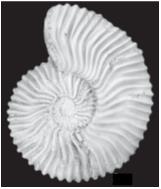
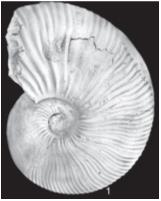
A few species. Bogdanova & Hoedemaeker (2004) describe 14 species from Colombia, in two main groups. The first group shows late rib bifurcations and possible umbilical bullae, at stage 3. Neodeshayesites columbianus (Riedel, 1938) is the most common Colombian species. This species has a venter that becomes increasingly narrow with age and fine ribs with a nearly angular fold at mid-flank (top image). N. biplicatus Bogdanova & Hoedemaeker, 2004, displays whorls that increase rapidly in height and very dense ribs (bottom image). In the second group, the ribs cross the venter earlier and without ventrolateral elevations. At stage 3, they are interrupted by a smooth siphonal band. A good example is N. stutzeri (Riedel, 1938), which has a broad venter and mostly bifurcated ribs, with rather narrow spaces on venter. N. tuberculatus Bogdanova & Hoedemaeker, 2004, is characterized by ribs with distinct umbilical bullae.
Remarks. The species of this genus, some of which are very similar, were previously classified in Deshayesites, Hypacanthoplites, or Parahoplites. Etayo-Serna (1981) writes that the genus is only Albian: according to him, the supposedly Aptian specimens in the literature would come from poorly dated strata. However, some species illustrated by Bogdanova & Hoedemaeker (2004) exist in both the Upper Aptian of Villa de Leyva and the Lower Albian of Apulo (Colombia), such as N. albertoalvarezi Etayo-Serna, 1979. Only portions of sutures are known (Etayo-Serna, 1979): the vast majority of specimens come from bituminous limestones that poorly preserve sutures.