Created 2023/08/24
Updated 2025/10/08
Lyelliceras lyelli (Leymerie in d'Orbigny, 1841)
| Measurements |
D mm | H/D | T/D | O/D | H/T |
|---|
| CP-132 |
26 | 0.36 | 0.39 | 0.39 | 0.91 |
| Leymerie 1842 |
34 | 0.35 | 0.40 | 0.41 | 0.87 |
| Parona & Bonarelli 1897 |
45 | 0.33 | 0.48 | 0.38 | 0.69 |
| Kennedy & Klinger 2008a |
45.1 | 0.38 | 0.35 | 0.39 | 1.09 |
| CP-633 |
46 | 0.37 | 0.35 | 0.39 | 1.06 |
| CP-699 figuré |
48.9 | 0.35 | 0.31 | 0.44 | 1.13 |
| Age |
Origin |
|---|
Grey clay, lyelli subzone
benettianus zone, Middle Albian
|
Géraudot
Aube, France
|
Description.
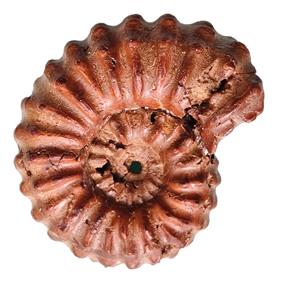
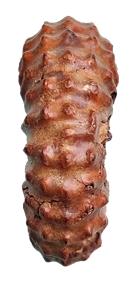
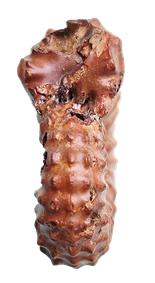
Small, pyritic phragmocone with inconspicuous sutures. Whorls 15% covered, with a slightly depressed, rounded section. 22 ribs, slightly rursiradiate and somewhat convex at the beginning of last whorl, then straight with intespaces as wide, originate on the umbilical slope and cross the siphonal line at right angle. Each rib bears a siphonal tubercle, pinched in the direction of siphon (a clavus) and, on each flank, a ventrolateral clavus of equal strength, a pimple-like lateral tubercle located at the upper third of the flank, and a more discrete periumbilical pimple. The ribs are slightly lower between the ventrolateral clavi and the siphonal clavus. The broad umbilicus, with a rather low wall and a quarter-circle profile, has its suture passing just above the lateral tubercles of the preceding whorl.
Remarks.
Personal discovery. A small anomaly is noted on the ventral view: a ventrolateral clavus connects two ribs, one of which terminates on the siphonal line. This species, with 20–25 ribs, has variable proportions; see our table and the section drawings by Latil (1994). The section becomes more compressed with growth and specimens exceeding 5 cm are rare. Latil also illustrates the suture line of several individuals: it is only slightly divided and shows five subquadrate saddles with a small median incision, and as many narrower rectangular lobes with three points.
This species defines the lyelli subzone, i.e. the upper half of the benettianus zone. The benettianus zone was long considered the last zone of Lower Albian, but since Birkelund et al. (1984), the lyelli subzone marks the beginning of the Middle Albian.
L. lyelli is abundant in the clays below the famous bed B of nodules, which marks the end of the benettianus zone in Aube. It becomes rare in bed B and then disappears above it.