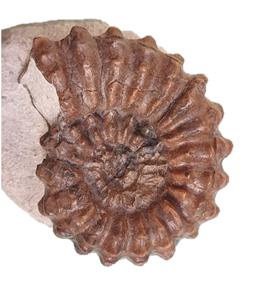
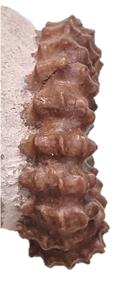
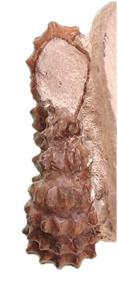
Lyelliceras lyelli – Other specimen
| Measurements |
D mm | H/D | T/D | O/D | H/T |
|---|
| CP-132 |
26 | 0.36 | 0.39 | 0.39 | 0.91 |
| Leymerie 1842 |
34 | 0.35 | 0.40 | 0.41 | 0.87 |
| Parona & Bonarelli 1897 |
45 | 0.33 | 0.48 | 0.38 | 0.69 |
| Kennedy & Klinger 2008a |
45.1 | 0.38 | 0.35 | 0.39 | 1.09 |
| CP-633 |
46 | 0.37 | 0.35 | 0.39 | 1.06 |
| CP-699 |
48.9 | 0.35 | 0.31 | 0.44 | 1.13 |
| Age |
Origin |
|---|
Nodule of bed B, lyelli subzone,
benettianus zone, Middle Albian
|
Courcelles
Aube, France
|
Description.
Specimen larger than CP-132, with part of its nodule. Typical preservation of Courcelles bed B, with a brown test on the internal mold in gray limestone. Whorls 20% covered, with a slightly compressed elliptical section. The body chamber, which occupies the last half-whorl, looks contracted laterally (on the ventral view, the opening is really at the top): during fossilization, the ammonite was probably compressed on this part lacking septa, which is why we give the H/T ratio just before the crushing. Regular ornamentation of 19 radial ribs, with interspaces more or less as wide, originates at the umbilical suture and crosses the siphonal line at right angle. Each rib bears four tubercles of decreasing strength on each flank: a siphonal clavus, a ventrolateral one, a lateral clavus at mid-flank, and a small, pointed umbilical tubercle. The wide umbilicus, with a fairly low wall and a quarter-circle profile, has its suture just above the lateral tubercles of the previous whorl.
Remarks.
L. lyelli is abundant at Courcelles in pyritic forms, in the clays of bed C. The most recent specimens, such as CP-699, much rarer but preserved with their shells, are found in the nodules of bed B, which marks the end of the benettianus zone in the Aube department. The species thus disappeared at the same time as Hoplites (Hoplites) bennettianus. Its size appears to be limited to 6 cm at Courcelles, but it can exceptionally reach 10 cm in diameter, according to a specimen from Saint-Florentin in the Yonne department, illustrated by Bayle in 1878.