Created 2023/04/26
Updated 2024/10/12
Hoplites (Hoplites) paronai Spath, 1925
| Measurements |
D mm | H/D | T/D | O/D | H/T |
|---|
| CP-709 figured
| 55.3 | 0.47 | 0.54 | 0.26 | 0.88 |
| CP-217 | 69.3 | 0.43 | 0.52 | 0.29 | 0.83 |
| Holotype | 73 | 0.43 | 0.57 | 0.32 | 0.75 |
| Age |
Origin |
|---|
Dentatus nodule bed (bed 1)
Lower Gault, Middle Albian
|
Folkestone
Kent, England
|
| Var. | dentatus | spathi | paronai |
|---|
| H/T | 1.21-1.32 | 0.92-1.02 | 0.67-0.83 |
| T/D | 0.32-0.40 | 0.49 | 0.52-0.70 |
Description.
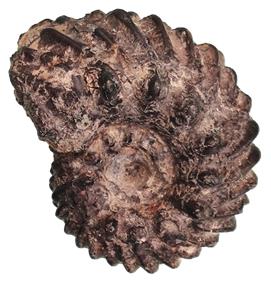
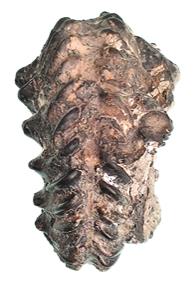
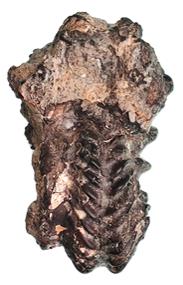
Read the entry for Hoplites (Hoplites) dentatus first. This ammonite, in black phosphate with one side not prepared, is completely septate and displays whorls that overlap by 50%, with a thick, depressed hexagonal section. The umbilicus is deep. Its raised wall, sloping at 70°, transitions to the flank via a rounded margin. Thirteen radial primary ribs originate from this wall and rise to form, shortly after the umbilical margin, very tall, radially pinched tubercles. Pairs of forward-curving ribs arise from these tubercles. The moderately raised terminations of ribs reach a 45° angle to the siphonal line. They alternate on each side and define a deep and straight groove with a flared U-shaped section.
Remarks.
The last table lists, in increasing thickness, the Hoplites species with U-shaped sulcus from the lower dentatus zone, based on the specimens from Spath (1925). They are currently considered variants of H. dentatus, which has anteriority (Amédro, 1992; Courville & Lebrun, 2010; Amédro et al., 2014). Our specimen corresponds to Hoplites (Hoplites) paronai, the thickest and least frequent variant. It generally displays a wider umbilicus than the other variants. The reader can see two other specimens: one on www.ammonites.org and one in Jaffré (2007, p. 79). Our ammonite has ribs that project further forward, and their ventral terminations begin to rise on the last half-whorl.