Hoplites (Hoplites) paronai – Other specimen
| Measurements |
D mm | H/D | T/D | O/D | H/T |
|---|
| CP-709 | 55.3 | 0.47 | 0.54 | 0.26 | 0.88 |
| CP-217 | 69.3 | 0.43 | 0.52 | 0.29 | 0.83 |
| Holotype | 73 | 0.43 | 0.57 | 0.32 | 0.75 |
| Age |
Origin |
|---|
Nodule from bed B, lyelli subzone,
benettianus zone, Middle Albian
|
Courcelles
Aube, France
|
| Var. | dentatus | spathi | paronai |
|---|
| H/T | 1.21-1.32 | 0.92-1.02 | 0.67-0.83 |
| T/D | 0.32-0.40 | 0.49 | 0.52-0.70 |
Description.
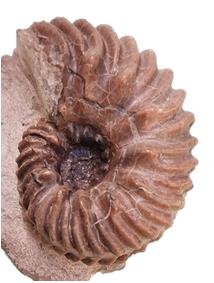
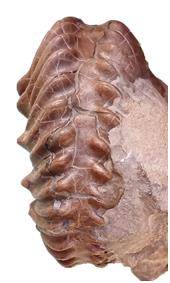
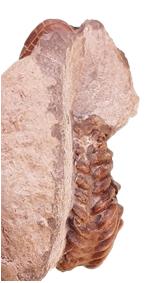
Read the entry for Hoplites (Hoplites) dentatus first. Ammonite with a brown test, incompletely freed from its nodule in gray limestone found in the famous Courcelles bed B. Sutures invisible. Whorls 60% covered, hexagonal in cross-section. Deep umbilicus, with a 60° sloping wall that passes to the flank via a rounded edge. Twelve slightly proverse primary ribs arise from this wall and bear, on the umbilical edge, at mid-height of the whorl, very tall, radially pinched triangular bullae. Pairs of forward-curved ribs extend from these bullae and gradually rise up to the ventrolateral shoulders. These ribs sag near the siphonal line, with which they form a 60° angle at the beginning of last whorl, narrowing to 45° close to the aperture. They alternate on each side and define a flat, straight groove. Some ribs separate from their bullae and there are a few intermediate ones, which gives a total of 32 ribs on last whorl.
Remarks.
The last table lists, in increasing thickness, the Hoplites with U-shaped sulcus from the lower dentatus zone, based on Spath's specimens (1925). They are today considered variants of H. dentatus, which has anteriority (Amédro, 1992; Courville & Lebrun, 2010; Amédro et al., 2014).
The H/T ratio of CP-709 falls between H. spathi and H. paronai, showing the existence of intermediate forms. We arbitrarily assign it to H. paronai, which has a slightly closer H/T ratio. CP-709 has a ventral groove that becomes particularly wide on the last half-whorl. Its ribs are less projected forward than CP-217.