Description. Type species Pachydiscus laevicaniculatus Lasswitz, 1904, by original designation (= Ammonites marcianus Schumard, 1854). The genus was separated from Pachydiscus by Wright in 1955. According to Kennedy, Wright & Chancellor (1983), Cobban (1987), and Wright (1996), these are moderately involute ammonites that can reach a large size, compressed to rather inflated, with a more or less narrowly rounded venter. The inner whorls often bear widely spaced, marked but shallow constrictions, traversing the venter and bordered by thick ribs, with or without intermediate ribs. Distinct umbilical bullae are sometimes present. With age, the ribs and constrictions become increasingly projected forward on the ventrolateral shoulders. The adult whorls are smooth or have straight, spaced ribs on the inner half of the flanks. The sutures have a trifid first lateral lobe and auxiliary sutures forming a line of regularly decreasing height. All these elements bear numerous small incisions. Lower Cretaceous (Upper Albian), Texas, New Mexico, Colorado, Oklahoma, South India.
Species. The literature mentions only three species: E. brazoensis (Schumard, 1860), E. laevicaniculatus (Lasswitz, 1904), and E. marcianus (Schumard, 1854). Kennedy, Wright & Chancellor (1983) consider the first to be a thick and highly ornamented variant of E. marcianus, while the second is another variant with weak ribs and constrictions. The genus is therefore currently reduced to E. marcianus, which has anteriority.
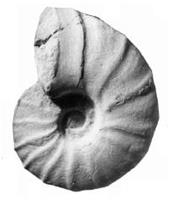
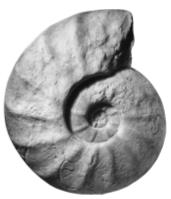
Remarks. The photographs show two Eopachydiscus from the Duck Creek Formation of Texas (Gale & Kennedy, 2020). The upper specimen, with its strong ornamentation, is a juvenile measuring 60.1 mm in diameter, from Spring Creek, Cooke County. Each rib is preceded by a wide but shallow constriction. The lower specimen is a less ornamented adult measuring 375 mm. Its constrictions are no longer visible, it is thinner, and shows a tendency to uncoil on the last whorl. It comes from Cedar Creek, southeast of Blum, Hill County. According to Kennedy, Wright & Chancellor (1983), the Eopachydiscus are the oldest Pachydiscidae and likely derived from Arraphoceras.