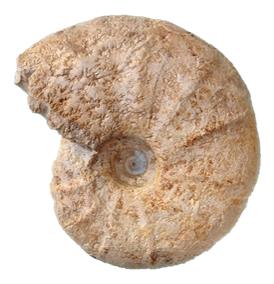
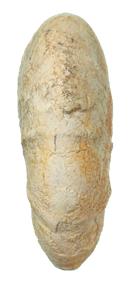
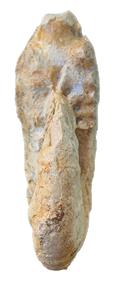
Eopachydiscus marcianus (Schumard, 1854)
| Measurements |
D mm | H/D | T/D | O/D | H/T |
|---|
| OUM KT10542* |
60 | 0.46 | 0.40 | 0.30 | 1.15 |
| CP-695 |
223 | 0.46 | 0.35 | 0.20 | 1.33 |
| USNM 6640859* |
420 | 0.35 | 0.30 | 0.38 | 1.17 |
* Specimens in Gale & Kennedy (2020)
| Age |
Origin |
|---|
Limestones and marls
Duck Creek Formation
Upper Albian
|
Spring Creek, SW Gainesville
Cooke County
North Central Texas, USA
|
Description.
This internal mold is quite thick, entirely septate, and made of yellowish limestone. At the beginning of last whorl, the venter is chipped and the unfigured face is crushed. The whorls, 70% covered, have a moderately compressed ovoid section, with a broadly rounded venter and no distinct shoulders. The umbilicus is stepped, with a vertical wall rising on the last whorl and a narrowly rounded edge. On the last whorl, 11 rounded ribs, without tubercles, originate from the umbilical margin. Radial, slightly convex, and somewhat irregularly spaced, they cross the venter in a straight line. The last two ribs flatten and spread. Each rib is bordered posteriorly by a shallow constriction, visible in raking light on the upper half of the flanks and the venter. The spaces between the ribs are slightly concave on the lower two-thirds of the flanks.
The sutures visible on the flanks show a broad, splayed main saddle with a median incision, and a slightly narrower, trifid first lateral lobe. The other elements form a radial alignment of decreasing height towards the umbilicus, with saddles twice as wide as the lobes. All the elements bear numerous small incisions.
Remarks.
This species sometimes has bullae at the base of the ribs and one to three intermediate ribs in the outer half of the flanks. Involution, shell thickness, and strength of ornamentation are quite variable. The Upper Albian of North-Central Texas includes, from bottom to top, the Kiamichi, Goodland, Duck Creek, Fort Worth, Denton, Weno, and Pawpaw Formations (Gale & Kennedy, 2020). The Duck Creek Formation consists of calcareous beds with thin marly layers. It corresponds to three ammonite zones: Elobiceras (Craginites) serratescens, Eopachydiscus marcianus, and Mortoniceras (M.) equidistans. The E. marcianus zone, which is equivalent to the inflatum zone in Western Europe, locally contains a true bed of this ammonite, with specimens reaching 60 cm.