Description. The type species is Schloenbachia elobiensis Szajnocha, 1885. According to Wright (1996), this genus has a smooth ventral keel, like all members of the subfamily Mortoniceratinae. It is rather evolute and compressed, with rounded ribs crossed by numerous fine ridges oriented in the direction of the coiling (clavi). It is found in the Upper Albian of Angola, South India, Nigeria, and Texas. It comprises two subgenera, Elobiceras and Craginites.
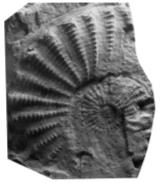
Subgenus Elobiceras. The subgenus Elobiceras sensu stricto has identical, simple, straight, and radial ribs. Its distribution is that of the genus. The upper image represents the holotype of the type species, Elobiceras (Elobiceras) elobiense.
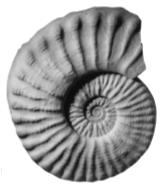
Subgenus Craginites. The subgenus Craginites Young, 1957, has somewhat flexuous or curved ribs, alternately long and short. It is restricted to Texas. Young defined it based on a single species, Elobiceras (Craginites) serratescens (Cragin, 1893). In a work on the Upper Albian of Texas, Gale & Kennedy (2020) modified the diagnosis by analyzing more specimens. In fact, Craginites can have ribs arising in pairs from the umbilical margin, and one species, C. simplex, even has a majority of simple, straight ribs, like Elobiceras. A better distinguishing criterion for Craginites is the presence of one or two rows of ventrolateral tubercles, while Elobiceras has ribs with broadened and flattened ends. Among the Texas ammonites studied, Gale & Kennedy added to the subgenus Schloenbachia neuparthi Choffat, 1905, Elobiceras subelobiense Spath, 1922 (lower image, from their article), and two new species: E. (C.) sparcicostatum and E. (C.) simplex.
Remarks. 1. Other Brancoceratidae from the Upper Albian may have a keel and ribs with spiral clavi, such as Mortoniceras (M.) inflatum (J. Sowerby, 1818) and Dipoloceras (Rhytidoceras) elegans (Van Hoepen, 1931). However, they have distinct umbilical tubercles, and the clavi disappear on the body chamber. 2. E. (C.) neuparthi, E. (C.) simplex, and E. (C.) subelobiense have a single row of ventrolateral tubercles, while E. (C.) serratescens and E. (C.) sparcicostatum have two. 3. In addition to the geographical range indicated by Wright (1996), one species has been reported in France in the Hautes-Alpes: Elobiceras (Craginites) newtoni Spath, 1925 (Gale et al., 2011).