Created 2024/09/30
Updated 2024/11/22
Elobiceras (Craginites) subelobiense Spath, 1922
| Measurements |
D mm | H/D | E/D | O/D | H/E |
|---|
| RJ-1729 |
100,8 | 0,40 | 0,38 | 0,32 | 1,04 |
| USNM 640884c* |
116 | 0,40 | 0,34 | 0,33 | 1,18 |
| USNM 640885c* |
135 | 0,37 | 0,27 | 0,36 | 1,36 |
* Specimens in Gale & Kennedy (2020)
| Age |
Origin |
|---|
Yellowish limestones
Eopachydiscus marcianus zone
Duck Creek Formation
Upper Albian
|
Rock Creek
North-West of Joshua
Johnson County
North Texas, USA
|
Description.
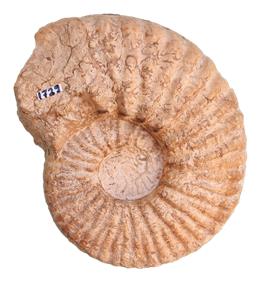
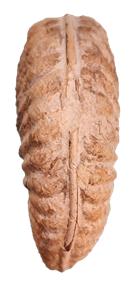
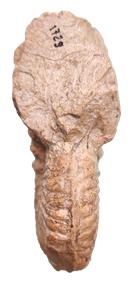
Fully septate internal mold in limestone, with whorls 20% covered. It has a trapezoidal whorl section, slightly convex flanks, broadly rounded ventrolateral shoulders, and a flat venter with a thin, semicircular keel. The vertical umbilical wall is connected to the flank via a rounded edge.
22 ribs form a low bulla at the umbilical margin, where many bifurcate. With shorter intercalary ribs, there are 40 ribs that widen towards the top while becoming all similar. They rise just before the ventral shoulder to form a broad bulla that spreads out near the keel.
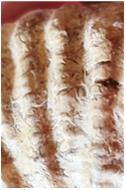
At the beginning of last whorl, the ribs are somewhat flexuous, with narrow interspaces. They then become straighter, with interspaces of equal width, except between the ventrolateral tubercls where they remain narrow. The ribs are worn but show 16-17 clavi in raking light (photo on the right).
The barely visible suture resembles that of Mortoniceras inflatum (Wright, 1996, fig. 109-g). L1 with a long, narrow trunk, with two small median branches perpendicular to the trunk and a trifid extremity.
Remarks.
The species compresses with age and the umbilicus widens (see table). I was unable to obtain Spath's article, but the ammonite is described again in Haas (1942) and Gale & Kennedy (2020). Our specimen corresponds well to plates VI-VII of the latter. The Duck Creek Formation of Texas includes the Elobiceras (Craginites) serratescens, Eopachydiscus marcianus, Mortoniceras (M.) equidistans, and Angolaites lasswitzi zones. The marcianus zone corresponds to the base of our inflatum zone (Gale & Kennedy, 2020, figs. 2, 6).