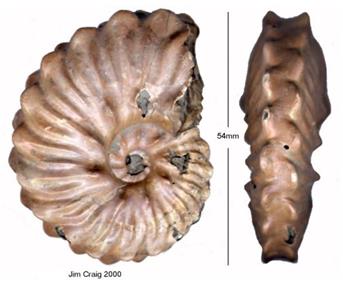
Description. According to Spath (1925) and Wright (1996), this genus is more or less evolute, rather compressed, with a flat or slightly concave venter. The ribs are strong, generally lautiform, and persist to the end of the body chamber. They terminate in ventrolateral clavi that are more or less parallel to the siphon. According to Young et al. (2010), it probably includes forms with different ancestors. The type species is Ammonites biplicatus Mantell, 1822. This genus is found in the Middle and Upper Albian of Europe, Transcaspia, and Greenland.
Species. Amédro (1992) proposed grouping the majority of forms into four species with a wide spectrum of variation, in order of appearance:
Dimorphoplites niobe Spath, 1926, has bifurcated or alternately long and short ribs; see a specimen in Young et al. (2010). Its typical forms are found in beds III and IV of Folkestone (level P4 at Wissant), and it defines the Middle Albian ammonite zone between the Anahoplites intermedius zone and the Dimorphoplites biplicatus zone. Its appearance is difficult to pinpoint precisely because there are transitional forms with A. intermedius in bed II (intermedius zone). Furthermore, it is difficult to distinguish from the robust variant A. praecox of A. intermedius.
Dimorphoplites doris Spath, 1926, has irregularly developed lautiform ribs that project strongly forward on the periphery. D. pinax Spath, 1926, is a finely ribbed variant. Bed IV of Folkestone, upper niobe zone, Middle Albian.
Dimorphoplites biplicatus (Mantell, 1822) has lautiform ribs and rounded ventrolateral clavi. It defines the ammonite zone that follows the niobe zone. Its spectrum of variation includes, from most compressed to thickest: D. glaber Spath, 1926; D. chloris Spath, 1926; D. tethydis (Bayle, 1878); D. biplicatus; D. parkinsoni Spath, 1923. The acme is located in beds V to VIII at Folkestone (level P5 at Wissant), but transitional forms from D. niobe and D. doris appear already in bed IV. This species can be difficult to distinguish from Otohoplites subhilli (ex-bulliensis) from Lower Albian, hence the importance of knowing the collection level and/or associated ammonites. The photographs on the left illustrate a D. parkinsoni from Jim Craig's site.
Dimorphoplites silenus (Spath, 1926) has a body chamber with lautiform ribs, but internal whorls with simple ribs or ribs arising in bundles of two or three. It forms a transition to Metaclavites compressus and appears to be restricted to the base of bed VIII of Folkestone, cristatum zone, base of Upper Albian.
| Dimorphoplites (3) | biplicatus | chloris | glaber |