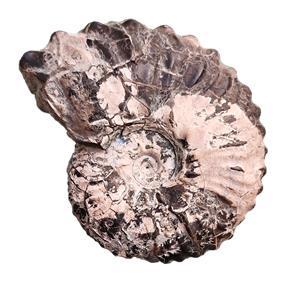
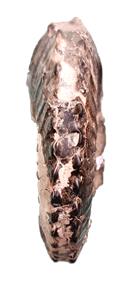
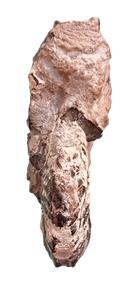
Dimorphoplites chloris Spath, 1926
| Measurements |
D mm | H/D | T/D | O/D | H/T |
|---|
| Holotype | 63 | 0.49 | 0.30 | 0.18 | 1.56 |
| CP-454 | 70.2 (52.4) | 0.46 | 0.28 | 0.25 | 1.65 |
| CP-107 | 86.1 | 0.44 | 0.31 | 0.25 | 1.41 |
| Age |
Origin |
|---|
Grey clay, phosphatic level P5
cristatum zone, Upper Albian
|
Wissant, Pas-de-Calais
France
|
| Var. | glaber | chloris | tethydis
| biplicatus | parkinsoni |
|---|
| H/T | 1.85-2.10 | 1.41-1.63 | 1.09-1.45 | 0.95-1.08 | 0.95-1.00 |
| T/D | 0.23-0.26 | 0.30-0.32 | 0.33-0.42 | 0.36-0.42 | 0.43-0.44 |
Description.
A flat ammonite made of black phosphate, with test remains in the form of a pinkish film. The first half of last whorl is worn, with ribs difficult to count. The other half, better preserved, corresponds to the body chamber, which thickens over the last 60°, with the height-to-thickness ratio decreasing from 1.57 to 1.41. The whorls, half-covered, have a tall trapezoidal section. The flanks are initially almost flat, with little convergence. In the outer third, they become more convex and converge towards a narrow, slightly concave venter. The umbilicus has a low, straight wall, sloping at 80°. It joins the flank via a narrowly rounded edge.
On the last half-whorl, there are 8 small, prominent, pinched, and proverse periumbilical bullae. Each gives rise to two sigmoid ribs, curved forward in the outer third of flanks and connected to 16 rounded ventrolateral clavi, parallel to the siphonal line and alternating on either side. Most pairs of ribs terminate at the same clavus (lautiform ribs), but some end at two successive clavi (zigzag ribs). Including a few intermediate ribs without umbilical bullae, there are 22 ribs in total on the last half whorl.
Remarks.
The last table lists the species of Dimorphoplites with lautiform ribs, in order of increasing thickness and ornamentation, with measurements of Spath's specimens (1926). They are found from the top of niobe zone to the base of cristatum zone. According to Amédro (1992), these are variants of D. biplicatus. Four species from this series, from bed VIII of Folkestone, are shown on
Jim Craig's website.
In my opinion, his 44 mm D. chloris with delicate ribs is more likely a D. glaber. There is no precise boundary between these variants, but our ammonite is a D. chloris according to its H/W ratio.