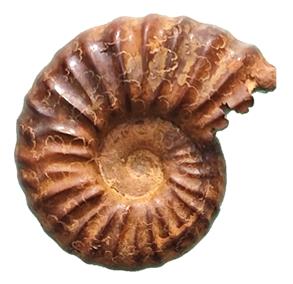
History. This genus has a complex history and its current boundaries are still unclear. Steinmann (1881) creates it for two small Albian ammonites with simple ribs crossing venter: Ammonites senequieri d'Orb., 1841, from southeastern France, with a weak ventral keel, and a new Peruvian species, B. aegoceratoides, unkeeled. Spath (1923) adds B. cricki from the English Albian. Breistroffer (1951) limits the genus to forms with a keel or a fastigiate venter, at least in juveniles, and creates the genus Eubrancoceras for unkeeled forms, type E. aegoceratoides. Gebhard (1979) reclassified Eubrancoceras as a subgenus of Brancoceras.
For the Middle Albian of the Anglo-Paris Basin, Owen (1971, p. 152-155) lists B. (B.) senequieri, B. (B.) versicostatum (Michelin, 1838), B. (E.) aegoceratoides and B. (E.) cricki. He was the first to place Michelin's Ammonites versicostatus in the genus Brancoceras. Marcinowski & Wiedmann (1990) assign Polish specimens of Brancoceras versicostatum to the subgenus Eubrancoceras. In the Treatise, Wright (1996) validates Eubrancoceras as a subgenus of Brancoceras.
Kennedy (2004) created the genus Pseudobrancoceras (see its entry) for irregularly ribbed species such as B. (B.) versicostatum. These are contemporary homeomorphs of Brancoceras, which he moved to the Lyelliceratinae. He uses Brancoceras and Eubrancoceras as two separate genera, and his diagnosis of Brancoceras accepts both keeled and non-keeled forms. He includes in his plates some Eubrancoceras aegoceratoides, without recalling the diagnosis of the genus and without explaining why he retains it, since he accepts the forms without keel in Brancoceras. Kennedy & Klinger (2008) write that Eubrancoceras is possibly a small, pedomorphic descendant of Prolyelliceras matthewsi (see its entry). Amédro & Matrion (2014) cite Eubrancoceras cricki at Folkestone.
Description. According to Kennedy (2004), these are small, evolute to moderately involute ammonites with an elliptical to subrectangular whorl section. Juveniles are ribbed from the start or exhibit a smooth or weakly ornamented initial stage of varying duration. Subsequently, simple or paired primary ribs appear, with or without umbilical bullae. In adults, the ribs are simple. Radial constrictions of the shell may be present. The ribs cross the venter radially or forming a chevron, or stop against a more or less pronounced siphonal keel. The suture line is simple, slightly incised, with rounded saddles and narrower rectangular lobes. Genus found from the Middle Albian to the basal Upper Albian. England, France, Poland, India, Madagascar, Colombia, Venezuela, Peru, Texas.
Remarks. We follow Kennedy (2004) and Kennedy & Klinger (2008) here. 1) Genus Brancoceras includes keeled and non-keeled forms and has no subgenus. 2) Genus Eubrancoceras is retained for E. aegoceratoides from Peru, pending further studies to determine its true justification. In the Aube region, we find B. flexuosum (photo) and B. multicostatum, two species defined by Kennedy (2004).
| Brancoceras and Eubrancoceras (4) | Eubrancoceras aegoceratoides | Eubrancoceras quenstedti | Brancoceras aff. flexuosum | Brancoceras aff. multicostatum |