Created 2024/03/24
Updated 2024/12/01
Brancoceras aff. flexuosum Kennedy, 2004
| Measurements |
D mm | H/D | T/D | O/D | H/T |
|---|
| CP-649 | 16.9 | 0.40 | 0.41 | 0.34 | 0.97 |
| CP-648 | 18.2 | 0.39 | 0.38 | 0.35 | 1.02 |
| CP-647 | 19.1 | 0.39 | 0.35 | 0.34 | 1.12 |
| Age |
Origin |
|---|
Grey clay
L. lyelli subzone
H. benettianus zone
Middle Albian
|
Le Gaty
Géraudot
Aube
France
|
Description.
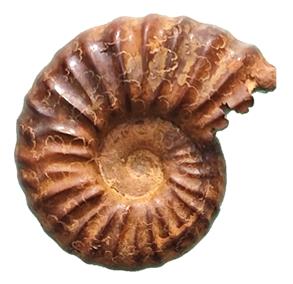
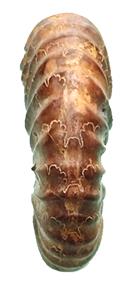
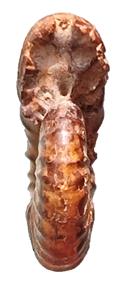
Small, pyritic phragmocone with whorls 30% covered and a compressed rectangular whorl section. Umbilicus with a low wall sloping at 70° and a rounded edge. The inner whorls are smooth until the beginning of the last whorl (around 12 mm in diameter), then bear 26 simple ribs. They are prorsiradiate, straight or convex, then flexuous at the end of the spiral. They originate at the umbilical suture, reach their maximum thickness just past the umbilical edge, remain strong on the flanks, then flatten slightly on venter, where they draw a convex sinus. A few shorter intercalary ribs are present. The well-exposed sutures are typical of genus Brancoceras: round saddles with a small median incision and narrower, rectangular, trifid lobes, with L1 half the width of S.
Remarks.
Personal discovery. Kennedy (2004) illustrated two specimens from the lyelli subzone of Aube, only one of which was measured. They have a compressed whorl section, smooth inner whorls, and 20 ribs, effaced or attenuated on the siphon. In the same article, Kennedy defines another species from the same level, B. multicostatum, with two measured specimens: they have a depressed whorl section, ribbed inner whorls, and 25-26 strong ribs on venter (see its entry). The sutures of these two small Brancoceras are very similar, but with narrower lobes in flexuosum.
CP-647 is therefore close to B. flexuosum (more or less compressed section, smooth inner whorls), except for its number of ribs, which corresponds to the other species! In fact, we have 6 other specimens (2 of which are in the table) that show varying proportions and a number of ribs ranging from 20 to 27. Maybe this variability was not visible on the too small number of Kennedy ammonites. The relevant criteria for distinguishing flexuosum would therefore be smooth internal whorls and a circular to compressed cross-section.