| Measurements | D mm | H/D | T/D | O/D | H/T |
|---|---|---|---|---|---|
| David Jolly | 17 | 0.38 | 0.35 | 0.29 | 1.08 |
| Holotype | 26.4 | 0.35 | 0.30 | 0.35 | 1.16 |
| Age | Origin |
|---|---|
|
Middle Albian Lyelliceras lyelli Malagasy zone |
Ampanihy Boeny Region Madagascar |
| Measurements | D mm | H/D | T/D | O/D | H/T |
|---|---|---|---|---|---|
| David Jolly | 17 | 0.38 | 0.35 | 0.29 | 1.08 |
| Holotype | 26.4 | 0.35 | 0.30 | 0.35 | 1.16 |
| Age | Origin |
|---|---|
|
Middle Albian Lyelliceras lyelli Malagasy zone |
Ampanihy Boeny Region Madagascar |
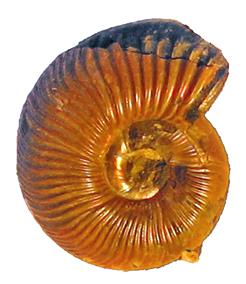
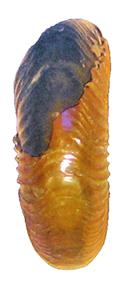
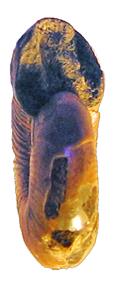
Description. A small, rather evolute ammonite with an elliptical whorl cross-section. The thin, dense, and flexuous ribs originate in the umbilicus with a rounded wall and rise rapidly, with narrow and deep intercostal spaces. Some bifurcate just after the umbilical shoulder. Near venter, they project forward, and some divide further, resulting in 68 ribs in total. Finally, they are attenuated on venter, which they traverse to form a linguiform sinus. Seven constrictions, following the same course as the ribs, are distinct on venter but not on the flanks, where they appear as a deepened and slightly widened intercostal space. On the visible portions of the internal mold, the ribs are hardly visible, but the constrictions are more pronounced.
Remarks. This very rare species was previously known only from South Africa: this specimen is therefore the first record in Madagascar. This presence is not surprising, as South Africa and Madagascar were contiguous at Albian time. The numerous South African specimens illustrated by Kennedy et al. (1979) exhibit 6 to 12 constrictions per whorl. These are narrow but deep when the test is absent. In some specimens, they are almost completely filled when traversing the siphonal line. Others have a body chamber on which the ribs become concave and strongly projected forward. A minority of specimens, among the largest ones, display a few ventrolateral pustules here and there, covering one to three ribs in width. According to Kennedy et al. (1979), these pustules formed the base of septate spines, which have not been preserved. Thanks to David Jolly for lending us his specimen!