Created 2023/07/27
Updated 2023/09/12
Stoliczkaia (Stoliczkaia) notha (Seeley, 1865)
| Measurements |
D mm | H/D | T/D | O/D 1 | H/T | Ribs 2 |
|---|
| CP-136 |
78.2 | 0.42 | 0.35 | 0.09-0.21 | 1.18 | 22-15 |
| CP-270 |
85.3 | 0.46 | 0.32 | 0.11-0.20 | 1.37 | 17-12 |
| CP-269 |
92.7 | 0.41 | 0.35 | 0.11-0.23 | 1.17 | 15-12 |
| CP-221 |
97.8 | 0.46 | 0.31 | 0.12-0.19 | 1.45 | 23-11 |
1 Beginning and end of last whorl.
2 On the 1st and 2nd half of last whorl.
| Age |
Origin |
|---|
Base of Pénzeskút marls
Condensed Upper Albian
rostratum to perinflatum zones
|
Tilos forest
Village of Pénzesgyõr
Bakony Hills, Hungary
|
Description.
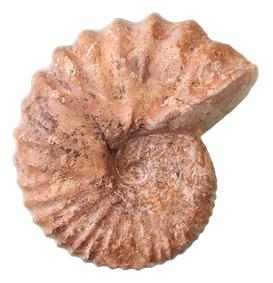
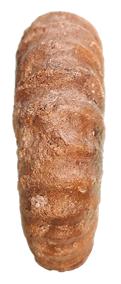
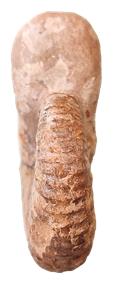
Involute and compressed shell with test. The body chamber occupies the last half-whorl. Before it, the whorls have flat, slightly convergent flanks and a rounded but slightly flattened venter with distinct shoulders. The narrow umbilicus has a flat wall at 80°, connected to the flank via a rounded edge. The fine, closely spaced ribs (22 on the penultimate half-whorl) alternate between long and short. The long, proverse ribs, straight or slightly sinuous, originate at the umbilical margin, the short ones mid-flank. These ribs cross the venter with a broad proverse sinus.
On the body chamber, the flanks begin to diverge slightly; the venter becomes rounded, and its shoulders become indistinct. The ribs swell on the upper half of the flanks and especially on venter. However, they sag at the bottom of the flank, and some of the long ribs no longer reach the umbilical margin. Their number decreases (15 on the last half-whorl) and they cross the ventral side in a straight line. The chamber contracts vertically on the umbilical side, making the ammonite less involute.
Remarks.
On the body chamber, the fewer but swollen ribs at the top of the flanks and on venter, as well as the opening umbilicus, are typical of this species. The table indicates a variable H/T ratio and more spaced ribs on body chamber. At the end of last whorl, specimen 270 has more attenuated ribs at the bottom of the flanks, 269 has stronger, bulging ribs at the top of the flanks, and 221 has the tallest section.
All these specimens from the Bakony Mountains were found in fossil shows under the name S. (S.) dispar. Although present in the same layer, this species is quite different; see the genus entry.
S. (S.) notha is known from the Anglo-Paris Basin in the fallax zone of Upper Albian (base of Vraconian). In Hungary, it comes from a level condensing the fallax and perinflatum zones.