Created 2023/02/17
Updated 2023/10/26
Sonneratia (Eosonneratia) vnigri var. typica Saveliev, 1973
| Measurements |
D mm | H/D | T/D | O/D | H/T |
|---|
| 3731 holotype |
57.5 | 0.48 | 0.45 | 0.20 | 1.07 |
| CP-392 |
67.1 | 0.48 | 0.47 | 0.23 | 1.03 |
| CP-425/1439 |
69.1 | 0.43 | 0.42 | 0.25 | 1.03 |
| S. ciryi holotype |
49 | 0.45 | 0.47 | 0.26 | 0.96 |
| Age |
Origin |
|---|
S. vnigri zone of Mangystau
S. kitchini and C. floridum
zones of England and France
Lower Albian
|
Besakty
North-Aktau Ridge
Mangystau Peninsula
Kazakhstan
|
Description.
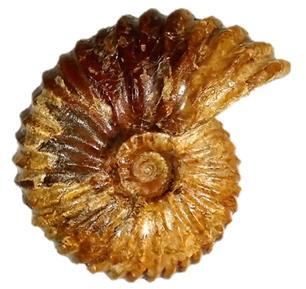
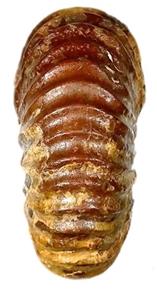
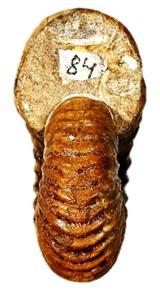
Thick and very involute shell, with a 75% whorl overlap. The slightly compressed oval whorl section, without distinct ventrolateral shoulders, reaches its maximum thickness at the inner third of the flanks. The umbilical wall begins with a steep 70° slope, then gradually transitions to the flanks via a rounded edge bearing 17 elongated umbilical bullae. These bullae give rise to bifurcated, somewhat sigmoid, and moderately prominent ribs, reaching their maximum height on the venter, which they cross with a sinus at 140°. Including a few intermediate ribs, there are 38 ribs in total on last whorl. On the body chamber, which occupies the last half-whorl, the venter widens slightly, and the bullae extend almost halfway up the flanks. Conforms to the Russian description by Saveliev (1992).
Remarks.
A species from Mangystau and Anglo-Paris Basin. The holotype grows quite rapidly in height. The "Sonneratia quercifolia" in the Auxerre Museum (Ricordeau collection no. 979) belongs in fact to this species. Saveliev (1992) distinguishes a variety tenuicostata, less thick and with thinner and more numerous ribs: see its entry. We add S. ciryi Destombes in Rat (1979) to the table, a junior synonym according to Owen (1988).
Matrion (2010, fig. 100) illustrates three Sonneratia flava specimens from Aube. However, per Casey (1965, p. 532), this species has a subtriangular cross-section, very prominent umbilical bullae, and fewer ribs (27). Only specimen 100C complies: the others, 100B and 100D, which have a largely rounded venter, less prominent bubbles and about forty ribs, are S. vnigri typica.