Created 2023/02/17
Updated 2023/05/18
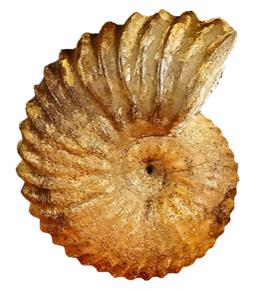
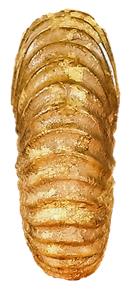
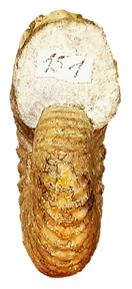
Sonneratia (Eosonneratia) vnigri var. tenuicostata Saveliev, 1973
| Measurements |
D mm | H/D | T/D | O/D | H/T |
|---|
| 3742 Saveliev endotype |
48 | 0.49 | 0.43 | 0.21 | 1.14 |
| CP-414/151 |
48.3 | 0.46 | 0.41 | 0.22 | 1.13 |
| Age |
Origin |
|---|
S. vnigri zone of Mangystau
S. kitchini and C. floridum
zones of England and France
Lower Albian
|
Besakty
North-Aktau Ridge
Mangystau Peninsula
Kazakhstan
|
Description.
The shell is moderately thick, very involute, with whorls that overlap by 70%. The oval whorl section, with a broadened and rounded venter, reaches its maximum thickness slightly above the umbilical wall. The latter is almost vertical in the inner whorls, then becomes less steep, with a lower slope of 70% and the top that curves towards the flanks. Eighteen elongated umbilical bullae give rise to bifurcated ribs, quite thin, arched or barely sigmoid. They reach their maximum height on the venter, which they traverse with a sinus at 140°. There are a total of 41 ribs on last whorl, including some simple ribs. The umbilical bullae are even more elongated on the body chamber, which is preserved over 120° of the last whorl.
Remarks.
Species only known in Mangystau. Saveliev (1992) defined two varieties for Sonneratia (Eosonneratia) vnigri: tenuicostata (our specimen) and typica (see its entry), which has a thicker cross-section (H/T = 0.96–1.07 vs. 1.07–1.21) and ribs of the same shape but stronger and slightly fewer in number. He writes that these two varieties coexist in the same deposits: although Saveliev never mentions sexual dimorphism in his publications, they may well be dimorphs.