Created 2023/02/22
Updated 2025/01/22
Sonneratia (Eosonneratia) tumida Saveliev, 1992
| Measurements |
D mm | H/D | T/D | O/D | H/T |
|---|
| 3343 Saveliev |
45.5 | 0.48 | 0.49 | 0.26 | 0.98 |
| 3723 Saveliev holotype |
56 | 0.49 | 0.55 | 0.22 | 0.89 |
| S. flava holotype |
63 | 0.46 | 0.48 | 0.23 | 0.96 |
| CP-445 |
71.5 | 0.46 | 0.50 | 0.25 | 0.93 |
| Age |
Origin |
|---|
S. vnigri zone
S. globulosa subzone of
Mangystau, Lower Albian
|
North-Aktau Ridge
Mangystau Peninsula
Kazakhstan
|
Description.
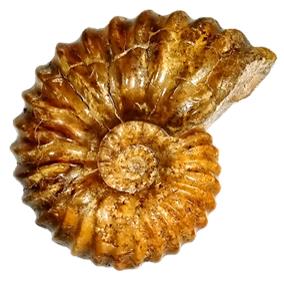
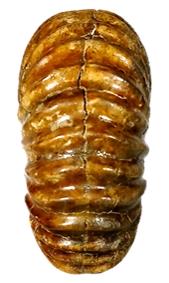
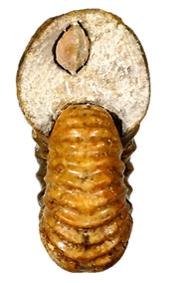
A very thick, involute ammonite with two-thirds covered whorls and body chamber on the last half-whorl. The whorl section is horseshoe-shaped initially, without distinct ventral shoulders, then the venter widens toward the rounded aperture containing a small bivalve. The 50° umbilical wall rounds to the flank. It bears 15 umbilical bullae that generate bifurcated, arched but radial ribs, which are even slightly rursiradiate on the first half of last whorl. These ribs are somewhat blunt, with slightly wider interspaces, and cross the venter with a 140° sinus that spreads over the body chamber. Some ribs are detached from their bulla, and a few shorter ones are also present. There are 29 ribs on the last whorl. This specimen corresponds well to the Russian description by Saveliev (1992).
Remarks.
The species was created by Saveliev (1974) without holotype (nomen nudum), then correctly defined in 1992. It resembles S. (E.) vnigri but has greater thickness (T/D = 0.48–0.55 vs. 0.38–0.43), a slightly more open umbilicus, and, most importantly, significantly fewer ribs (27–32 vs. 38–42).
We add the holotype of S. flava Casey (1965) to the table because it has similar proportions and number of ribs. However, its whorl section is subtriangular and its umbilical bullae are more prominent. According to Cooper & Owen (2012), S. (E.) tumida would be a junior synonym of S. chalensis Casey, 1965 (p. 543), but the latter has thicker and closer ribs.
The Auxerre Museum has a half-whorl from Hauterive, in the Yonne department, labeled "Sonneratia dutempleana" (Ricordeau collection no. 77-451-2). It can be linked to S. tumida based on its well-rounded whorl section and ribs: D = 72 mm, H/T = 0.97, T/D = 0.49, and 14 ribs (28 per whorl). The true S. dutempleana has a hexagonal section; see its entry.