Created 2023/01/26
Updated 2023/05/18
Sonneratia (Eosonneratia) rotula Saveliev, 1973
| Measurements |
D mm | H/D | T/D | O/D | H/T |
|---|
| 4/785 Saveliev (holotype) |
54 | 0.54 | 0.40 | 0.22 | 1.35 |
| CP-393 |
64 | 0.46 | 0.38 | 0.23 | 1.23 |
| S. ciryi compressa Destombes |
54 | 0.46 | 0.37 | 0.23 | 1.24 |
| Age |
Origin |
|---|
S. vnigri zone, S. rotula
subzone in Mangystau,
equivalent to C. floridum
zone in England
and France. Lower Albian
|
North-Aktau Ridge
Mangystau Peninsula
Kazakhstan
|
Description.
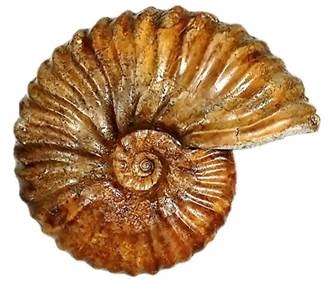
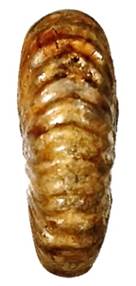
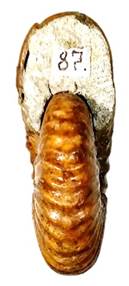
Compressed and highly involute ammonite with a subtrapezoidal whorl section and rounded ventrolateral shoulders. The venter is slightly flattened, widening over the body chamber which begins halfway through the last whorl. This whorl covers two-thirds of the previous one. The umbilicus is narrow and shallow. In profile view, 15 umbilical tubercles, inclined forward on the umbilical wall, extend along the lower flanks and then divide into two thin, sigmoid ribs that curve forward very high on the flanks. These ribs reach their maximum height on the venter, which they traverse, forming a sinus at a 130° angle to the front. The last whorl shows a total of 36 ribs, including 11 simple ribs, separated by wider interspaces. Sutures are invisible beneath the well-preserved test. Conforms to the Russian description by Saveliev (1973).
Remarks.
Species known from Mangystau. The closest relative, Sonneratia (Eosonneratia) caperata (see its entry), is less thick, with more numerous and less prominent ribs: T/D = 0.31–0.33 vs. 0.37–0.40 for rotula, H/T = 1.41–1.55 vs. 1.23–1.35. Furthermore, its first lateral lobe is more symmetrical according to Saveliev. Owen mentions (1988, pp. 191–192), that Sonneratia ciryi compressa Destombes, 1979, is a junior synonym of S. (E.) rotula. Specimen 235 illustrated in Rat et al. (1979, p. 81 and pl. 4-10, fig. 3a-b) however has a more pinched sinus, at 90°. We have added its dimensions in the table.