Created 2023/02/16
Updated 2023/05/18
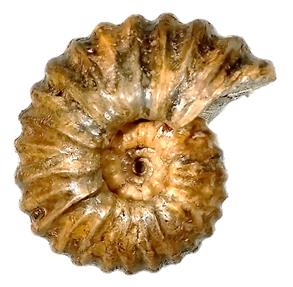
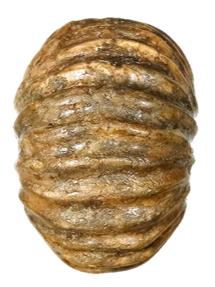
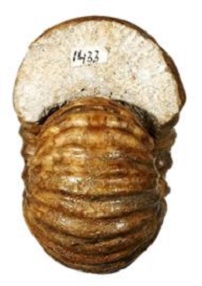
Sonneratia (Globosonneratia) perinflata Breistroffer, 1947
| Measurements |
D mm | H/D | T/D | O/D | H/T |
|---|
| BM C40129 holotype |
47 | 0.45 | 0.79 | 0.25 | 0.57 |
| 1219 Saveliev |
58.3 | 0.44 | 0.60 | 0.25 | 0.73 |
| CP-424/1433 |
71 | 0.44 | 0.68 | 0.22 | 0.65 |
| 1220 Saveliev |
75.8 | 0.42 | 0.62 | 0.25 | 0.68 |
| Age |
Origin |
|---|
S. vnigri zone. S. globulosa,
solida and rotula subzones
in Mangystau. S. kitchini zone
? in England and France
|
North-Aktau ridge
Mangystau Peninsula
Kazakhstan
|
Description.
Internal mold involute, very inflated, with whorls that overlap by two-thirds and a cross-section shaped like a horseshoe or a moon crescent. There is a tendency to uncoil for the body chamber, which occupies two-thirds of the last whorl. The venter and flanks are not distinct. Umbilicus narrow, deep, stepped, with an undercut umbilical wall. Fifteen elongated, radial, and slightly projecting umbilical bullae reach their maximum height at the line of maximum curvature of the umbilical margin. They give rise to bifurcated ribs with a rounded cross-section, slightly proverse and very slightly sigmoid, which form a weak sinus at 160° on the siphonal line. On the body chamber, the ventral sinus disappears, the ribs become more spaced and slightly retroverse, and the anterior rib of each pair often detaches from the umbilical tubercle to form an intermediate rib. There are 28 ribs in total on the last whorl.
Remarks.
This species is known in Europe and Transcaspia. In Europe, where it is rare, the kitchini zone is assumed because the specimens come from condensed levels. The table shows that the T/D and H/T ratios are variable. Casey (1965) and Saveliev (1992) described the evolution of whorl section: it is trapezoidal up to 2 cm in diameter, then the venter becomes rounded, and finally it becomes trapezoidal again around 6 cm. The largest known specimens are 8 cm long. S. (G.) coronatiformis Luppov, 1949, is a related species with more ribs (32-36) and can reach 16 cm. Its venter flattens later, around 11 cm.