Created 2023/02/24
Updated 2023/05/18
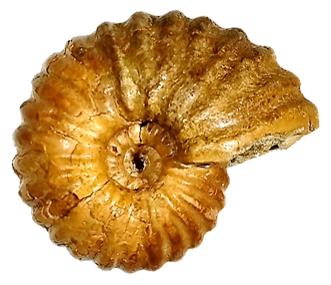
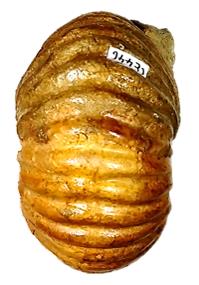
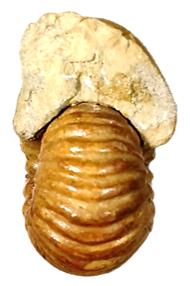
Sonneratia (Eosonneratia) luppovi Saveliev, 1960
| Measurements |
D mm | H/D | T/D | O/D | H/T |
|---|
| CP-415 |
41 | 0.44 | 0.63 | 0.22 | 0.69 |
| 1223 holotype |
51 | 0.55 | 0.64 | 0.26 | 0.86 |
| CP-446 |
62 | 0.46 | 0.62 | 0.22 | 0.74 |
| Age |
Origin |
|---|
S. vnigri zone
of Mangystau
Lower Albian
|
North-Aktau Ridge
Mangystau Peninsula
Kazakhstan
|
Description.
The shell is very thick and deeply involute, with a preserved test, a crescent-shaped whorl section, and the beginning of body chamber on the last quarter of whorl. The lower part of the umbilical wall is vertical, slightly undercut, while the upper part rounds toward the flanks. The maximum thickness is at the umbilical shoulder.
Thirteen faint bullae arise at the top of the umbilical wall, giving rise to pairs of bifurcated, low, well-rounded, and symmetrical ribs in cross-section, with narrow, regularly concave intervals. The ribs widen and reach their maximum height on the venter, which they traverse with a weak sinus at 150°. The intercostal space increases slowly and becomes as wide as the ribs near the aperture; concurrently, the ventral sinus disappears. Including a few simple ones, there are 27 ribs on the last whorl. This specimen corresponds well to the Russian description by Saveliev (1960).
Remarques.
This species from Mangystau is classified by Saveliev in Eosonneratia despite its thickness recalling S. (Globosonneratia) perinflata (see its entry). In fact, luppovi is less swollen (T/D = 0.63 vs. 0.73 on average) and has less depressed whorls (H/T = 0.76 vs. 0.59). Moreover, the whorl section rises on the siphon, hence its almost arched crescent shape.
This ammonite belongs to the subgroup of Eosonneratia with thick ribs and narrow intervals, with S. (E.) kitchini Spath, 1925, and S. (E.) rotator Casey, 1965. The kitchini of Spath and Casey have even wider ribs and are more compressed: T/D = 0.45-0.55 and H/T = 0.89-1.07. As for rotator, it has the proportions as luppovi, but with the wider ribs of kitchini and a broadened, slightly flattened venter, which gives it a sub-trapezoidal section.