Created 2023/02/14
Updated 2023/05/18
Sonneratia (Sonneratia) kulatensis Saveliev, 1992
| Measurements |
D mm | H/D | T/D | O/D | H/T |
|---|
| CP-401/112 |
38.2 | 0.45 | 0.41 | 0.24 | 1.04 |
| CP-413/150 |
51.4 | 0.46 | 0.45 | 0.23 | 1.03 |
| 2565 Saveliev holotype |
63.6 | 0.50 | 0.44 | 0.26 | 1.09 |
| Age |
Origin |
|---|
O. sinzowi zone, P. (H.) puzosianus
subzone of the Mangystau
Lower Albian
|
North-Aktau Ridge
Mangystau Peninsula
Kazakhstan
|
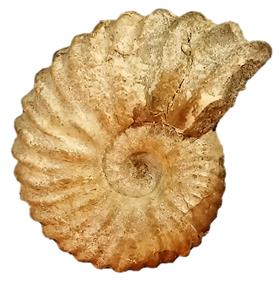
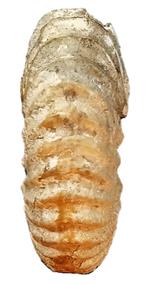
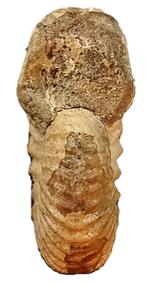
Description.
The whorls, which overlap by 50%, show a slightly compressed hexagonal cross-section, reaching its maximum thickness at the umbilical bullae. The venter is slightly convex, well separated from the flanks, which are somewhat wider, flat, and slightly convergent. The umbilicus spans one quarter of the diameter, with a wall sloping at 45°. The 16 umbilical bullae give rise to 32 paired, arched, slightly proverse ribs. These bullae extend over the body chamber, which occupies the last third of whorl, raising the point of bifurcation almost to mid-flank. Some ribs are detached from their tubercles. The ribs reach their maximum height on the venter, where they form a well-rounded, 140° proverse sinus. Their cross-section is asymmetrical, with a steeper posterior slope than anterior. This specimen corresponds well to the Russian description by Saveliev (1992).
Remarks.
This species is only recorded in Mangystau. It was named by Saveliev in 1974, but without designating a holotype (nomen nudum). This author correctly defined it in his 1992 book. At first glance, it could be confused with S. (S.) dutempleana, but our specimens of S. (S.) kulatensis and those of Saveliev are statistically distinct: they have taller, slightly compressed whorls (H/E ≥ 1.03 vs. H/E ≤ 0.98), a more closed umbilicus (O/D = 0.21–0.26 versus a very stable range of 0.29–0.32 in dutempleana), and a narrower venter. Furthermore, on specimens larger than ours, the ribs are higher on venter.