Created 2023/02/16
Updated 2026/01/08
Sonneratia (Sonneratia) intermedia Saveliev, 1992
| Measurements |
D mm | H/D | T/D | O/D | H/T |
|---|
| 2561 Saveliev | 69.5 | 0.43 | 0.44 | 0.26 | 0.98 |
| CP-389/80 | 86.5 (81.4) | 0.42 | 0.46 | 0.28 | 0.90 |
| 2566 Saveliev holotype | 107.5 | 0.50 | 0.43 | 0.28 | 1.16 |
| Age |
Origin |
|---|
O. sinzowi zone, P. (H.) puzosianus
subzone of the Mangystau
Lower Albian
|
North-Aktau Ridge
Mangystau Peninsula
Kazakhstan
|
Description.
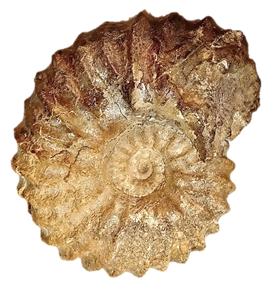
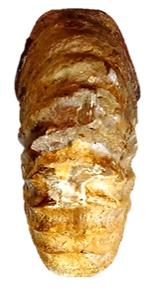
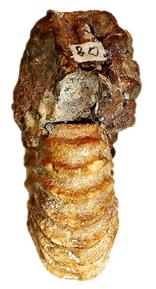
Specimen very similar to that of pl. 23, fig. 2 of Saveliev (1992). Internal mold in fine sandstone with small test remains and barely visible septa. The hexagonal section looks like it was hewn with an axe. It tends towards a trapezoid, as the broad venter and the flanks are flatter and the umbilical wall lower than in S. (S.) dutempleana. The ventral and umbilical shoulders are narrow and well-defined. Very regular ornamentation of 14 short umbilical bullae and 26 strong, high ribs, slightly curved forward, with wide and well-concave intercostal spaces. The ventral sinus is rounded and broad. The ribs reach their maximum thickness on the ventral shoulders, not on the siphonal line, as their crest is almost horizontal there while the venter remains slightly convex in the intercostal spaces. Simple ribs are in the minority (3). This specimen corresponds well to the description in Russian by Saveliev (1992).
Remarks.
Species known from Mangystau only. Saveliev created it in 1974 but without designating a holotype (nomen nudum): he formally defined it in 1992. It has the most robust ornamentation of subgenus Sonneratia sensu stricto. The table shows that the thickness is quite variable, but the shape of whorl section and the wide, well-concave intercostal spaces are characteristic. According to Saveliev, this species tends towards Tetrahoplites due to its slightly convergent flanks, flat and wide venter, and weak ventral sinus, hence its name (intermedia = intermediate).