Created 2025/07/20
Updated 2026/01/08
Sonneratia (Sonneratia) grandis Sinzow, 1907
| Measurements |
D mm | H/D | T/D | O/D | H/T |
|---|
| Sinzow pl.3 fig.1,2 |
116.5 | 0.44 | 0.38 | 0.26 | 1.15 |
| Sinzow pl.3 fig.3 |
235 | 0.46 | -- | 0.28 | -- |
| CP-587 |
281 (186) | 0.44 | 0.42 | 0.29 | 1.04 |
| CP-587 |
281 (258) | 0.41 | 0.38 | 0.28 | 1.09 |
| Age |
Origin |
|---|
Mangystau: O. sinzowi zone,
P. (H.)puzosianus subzone.
England, France: puzosianus
zone. Lower Albian
|
North-Aktau Ridge
Mangystau Peninsula
Kazakhstan
|
Description.
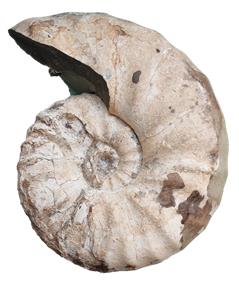
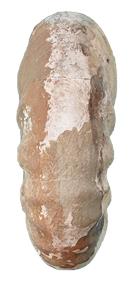
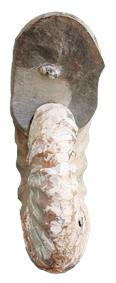
An enormous ammonite, 281 mm in diameter and weighing 7.2 kg, made of gray limestone, with a white test preserved on the figured side. The very oblique aperture reveals a small gastropod. On the first quarter of last whorl, the flank shown in profile view is crushed a bit. The body chamber is preserved over the last 120°. In the table, the diameter of 258 mm is measured vertically on profile view, thru the beginning of oblique aperture, while the 186 mm are measured at the beginning of last whorl. At this last point, the section is subhexagonal and bears 14 umbilical bullae, each forming two slightly concave ribs that cross venter with a shallow, broad, and rounded proverse sinus. The bullae then elongate, forming Y-shaped ribs, and on the body chamber they become large swollen ridges extending up to two-thirds of flanks. At the same time, the venter rounds out, the section becomes elliptical and the ribs sag strongly above the bullae and on the venter (detail noted by Sinzow).
Remarks.
Casey (1965, p. 520) attributes to Sonneratia dutempleana a similar large half-turn of 240 mm from Folkestone, with Y-shaped ribs branching at mid-flank. Saveliev (1992) believes that S. grandis is related to S. dutempleana, but with a narrower venter and a lesser thickness (T/D = 0.40 vs. 0.45–0.57). He acknowledges, however, that the appearance of juveniles of grandis is unknown and prevents precise comparisons with other species. Destombes in Rat (1979, p. 84) reports these large forms in the Lower Albian of the Perchois quarries (Aube). Because their H/T ratios are highly variable, he believes that several species of Sonneratia, ranging from compressed to thick, converge at the senile stage towards this common morphology, with very elongated and swollen umbilical bullae. Such convergence is also known in Hoplites, where senile H. benettianus and H. dentatus are difficult to distinguish (Courville & Lebrun, 2010).