Created 2023/03/01
Updated 2023/05/18
Sonneratia (Globosonneratia) globulosa Saveliev, 1973
| Measurements |
D mm | H/D | T/D | O/D | H/T |
|---|
| 1176 Saveliev holotype |
25.8 | 0.45 | 0.67 | 0.18 | 0.67 |
| 4146 Saveliev |
38.5 | 0.51 | 0.66 | -- | 0.77 |
| CP-113 |
46.5 | 0.51 | 0.68 | -- | 0.75 |
| Age |
Origin |
|---|
Phosphatic nodules, condensed level
S. kitchini to P. (H.) puzosianus zones
Lower Albian
|
Machéroménil
Ardennes
France
|
Description.
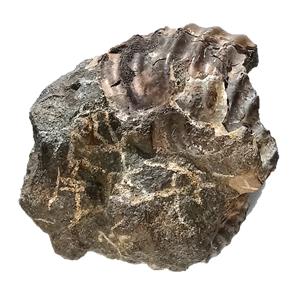
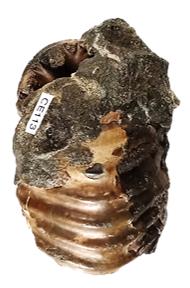
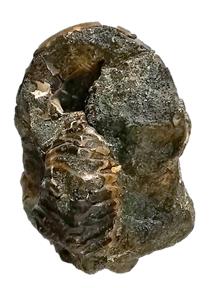
A reworked and unpreparable (too brittle) specimen in black phosphate, with remnants of coppery test. It is entirely septate and its umbilicus is obstructed. The whorls overlap by 65% and their section is semicircular. The slightly sigmoid ribs are fairly broad, with rounded crests. They arise in pairs from slightly prominent umbilical tubercles. They traverse the venter, forming a broad but somewhat angular sinus at 150°. The intercostal space is slightly wider than the ribs. The number of ribs is estimated at 36-38 per whorl.
Remarks.
Personal discovery. Species from the Anglo-Paris Basin (first recorded here) and the Mangystau. The reworked specimen comes from the famous level of "coquins" (phosphate nodules used as fertilizers) of Machéromesnil in the Ardennes, which provided d'Orbigny with numerous Albian species. This level condenses the upper part of the kitchini zone, the floridum and puzosianus zones, and the beginning of the subhilli zone.
Based solely on the "Soviet quality" photographs by Saveliev (1973), Owen (1988) considered the species synonymous with S. (G.) perinflata Breistroffer (see its entry). But Saveliev (1992) disagrees and emphasizes the differences. S. (G.) globulosa differs from perinflata by having a semicircular whorl section instead of a horseshoe shape, a greater internal height of the whorls (IH/D = 0.32–0.40 vs. 0.24–0.31), a lesser thickness (T/D = 0.66–0.72 vs. 0.74–0.84), a slightly narrower umbilicus, fewer and less broad ribs (36–38 vs. 25–32), and differences in the suture line.