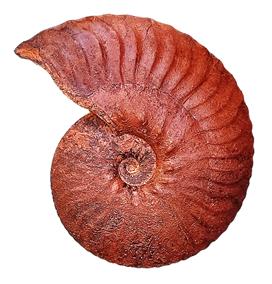
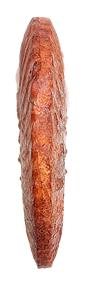
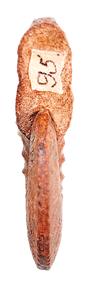
Semenoviceras (Planihoplites) uhligi (Semenov, 1899)
| Measurements |
D mm | H/D | T/D | O/D | H/T |
|---|
| CP-396 |
65.1 | 0.48 | 0.21 | 0.19 | 2.23 |
| 8083(2) Cecca |
87(68) | 0.53 | 0.23 | 0.16 | 2.32 |
| 8083(14) Cecca |
88 | 0.48 | 0.23 | 0.17 | 2.09 |
| Age |
Origin |
|---|
Upper Albian
S. litschkovi, S. michalskii,
and M. inflatum zones
|
Koksyrtau Hill
Mangystau Peninsula
Kazakhstan
|
Description.
A beautiful, very flat, involute, discoid ammonite with a brown test without visible sutures, preserved in gray sandstone. The whorls, 60% covered, increase in height quite rapidly. The body chamber is preserved on the last half-whorl. The whorl section is trapezoidal and highly compressed, with almost flat flanks, truncated by a flat and very narrow venter.
The umbilicus has a low wall that curves towards the flank. Its edge bears 15 small, slightly elongated, proverse bullae. Each bulla gives rise to 2 (sometimes 3) low, falcate ribs, weak up to mid-flank, with a steeper posterior slope. Between two consecutive pairs, there is often an intermediate pair originating in the inner half of the flanks, sometimes vaguely connected to a bulla. There are a total of 36 ribs, terminating in small ventrolateral clavi parallel to the siphonal line and alternating on either side.
The inner whorls visible in the umbilicus are smooth. The ribs and bullae are very faint at the beginning of the last whorl but visible in raking light. The ribs are initially sigmoid and only slightly proverse. Then their lower half becomes more and more inclined forward and elongates, giving a falcate appearance.
Remarks.
This species was named Hoplites uhligi by Semenov (1899), then long considered an Anahoplites (Amédro et al., 1977; Mikhailova, 1980). Saveliev (1992) designated it the type species of his subgenus Planihoplites within the genus Semenovites, renamed Semenoviceras by Wright in 1996. It is indeed a Semenoviceras because the suture line, illustrated by Mikhailova (1980), has low and broad elements.
The only diagnosis since Semenov is that of Cecca (1997). Cooper & Owen (2011a, fig.3, C-D-E-F) refigured two specimens from Sinzow (1910), which our specimen closely resembles. It is the most compressed (H/T > 2) and most delicately ornamented species of the genus.