Created 2023/12/09
Updated 2025/02/09
Semenoviceras (Semenoviceras) tamalakense (Saveliev, 1992)
| Measurements |
D mm | H/D | T/D | O/D | H/T |
|---|
| 1287 Saveliev |
65.5 | 0.39 | 0.27 | 0.32 | 1.44 |
| CP-417 |
68.2 | 0.42 | 0.26 | 0.29 | 1.64 |
| 1285 Saveliev |
72.4 | 0.41 | -- | 0.31 | -- |
| CP-397 |
80.3 | 0.46 | 0.24 | 0.25 | 1.88 |
| CP-637 |
82.9 | 0.44 | 0.24 | 0.25 | 1.87 |
| CP-638 |
89.9 | 0.44 | 0.24 | 0.28 | 1.86 |
| Age |
Origin |
|---|
Basal Upper Albian
S. litschkovi zone
|
Koksyrtau Hill
Mangystau, Kazakhstan
|
Description.
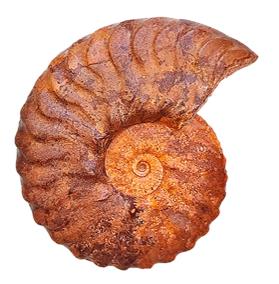
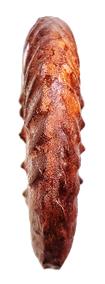
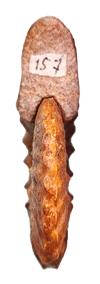
A somewhat evolute ammonite, with a brown test, whorls 45% covered and gradually increasing in height, and a body chamber spanning 200°. The tall, rectangular whorl section has slightly convex flanks on the outer quarter and a flat venter that rounds off at the end.
The umbilicus is broad, with a rather low wall at 45° and a rounded edge. The flanks are smooth up to the middle of the penultimate whorl. Then come small but pointed umbilical tubercles (11 on last whorl), giving rise to 2 (sometimes 3) proverse, falcate ribs, often followed by a shorter one beginning at mid-flank. Towards the top of the flanks, the 28 ribs widen, with a gentle anterior slope but a steep posterior one, forming regularly spaced concave crescents. They are cut slightly above the angular ventral margin to form sharp clavi. These clavi are parallel to the siphon, alternate on either side, and round off on the last half-whorl. The intercostal space slightly notches the ventral edge.
Remarks.
Named Semenovites (S.) tamalakensis by Saveliev, before the genus was renamed by Wright in 1996. It is named after Mount Tamalak, 13 km north of Shetpe, Mangystau. It is distinguished by its broad umbilicus and nearly parallel flanks. The section becomes higher with age, and the larger specimens (nos. 637-638) are very flat. According to Cecca (1997) and Kennedy & Walaszczik (2025), it is an evolute variant of S. (S.) michalskii. But the latter has more convergent flanks (hence a sub-triangular section), a smaller umbilicus, and more falcate ribs with very concave crescents: see Semenov (1899, 120-121, pl. 4 fig. 5a-d), Glazunova (1953, 74-75, pl. 22 fig. 3a-c), Ilyin (1961, 58-59, pl. 7 fig. 2a-b, pl. 8 fig. 1a-b, 2a-b and 3), Luppov (1961, 196-198, pl. 5 fig. 2a-b) and Sharifi et al. (2021, fig. 3, f-i). Cooper & Owen (2011a, 338, fig. 5a-b) depict a S. (S.) michalskii from the BMNH: it is in fact a S. tamalakense, given its open umbilicus, its rounded upper flanks, and its moderately falciform ribs.