Created 2023/04/13
Updated 2025/10/16
Puzosia (Puzosia) provincialis var. crassa Collignon, 1963
| Measurements |
D mm | H/D | T/D | O/D | T/E |
|---|
| Holotype P. provincialis | 22.5 | 0.40 | 0.40 | 0.31 | 1.00 |
| CP-39 var. crassa | 50 | 0.39 | 0.46 | 0.32 | 0.85 |
| Holotype var. crassa | 54 | 0.43 | 0.46 | 0.31 | 0.92 |
| R. Touch var. crassa | 58.5 | 0.38 | 0.45 | 0.32 | 0.85 |
| Age |
Origin |
|---|
Lower Albian
Malagasy zone of
Lemuroceras spathi &
Brancoceras besairiei
|
Ambarimaninga
Boeny Region
Madagascar
|
Description.
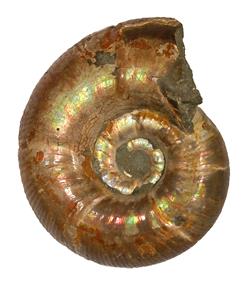
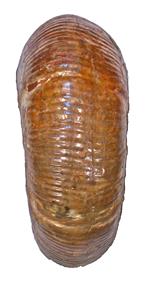
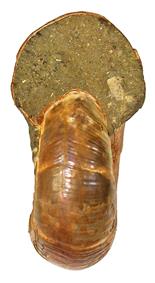
A thick specimen with the beginning of body chamber, an almost complete pearly test, whorls 45% covered, and a slightly depressed rounded whorl section. Maximum thickness is reached near the umbilicus with a rounded wall, which clearly exposes the inner whorls. Six constrictions notches the umbilical margin. They are slightly convex on the flanks and cross venter, the first with an undulation, the others perpendicular to the siphonal line. Normally, they should form a proverse ventral sinus, but it appears that an injury parallel to the siphon, at the beginning of the last whorl, affected them. Some are bordered backward by a thin ridge on the inner half of flanks. Between two constrictions, there are 16 to 21 fine, closely spaced ribs, visible only on the outer half of flanks. Sutures are invisible.
Remarks.
Most Puzosia are more or less compressed. The holotype of Puzosia (P.) provincialis by Parona and Bonarelli comes from Escragnolles. It is very small (22.5 mm) and has a cross-section as tall as wide. Collignon (1963) defines its variety by an even lower cross-section, but it could correspond to Puzosia lata Seitz, 1931. The species has been reported in France (Alps), the Balearic Islands, Madagascar, Poland, and Venezuela. Wright and Kennedy (1984) and then Kennedy et al. (2000) write that it includes microconchs of Puzosia (Puzosia) quenstedti. This claim is refuted by Latil et al. (2022), who collected a large number of P. (P.) quenstedti in Lieuche (Alpes-Maritimes), allowing them to identify all growth stages.
In the revision of Puzosia proposed by Wiedmann & Dieni (1968, see genus entry), the species P. (P.) provincialis is renamed P. (P.) mayoriana provincialis and is defined by an H/T ratio of 0.95-1.05. In the revision by Scholtz (1979), it becomes P. (Puzosia) planulata provincialis.