| Measurements | L mm | H mm | T mm | H/T |
|---|---|---|---|---|
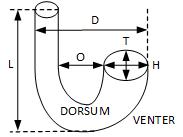
| CP-656 | 31.6 | 10.5 | 10.6 | 0.99 |
| Age | Origin |
|---|---|
|
Grey clay, dentatus zone Middle Albian |
Brévonnes Aube, France |
| Measurements | L mm | H mm | T mm | H/T |
|---|---|---|---|---|
| CP-656 | 31.6 | 10.5 | 10.6 | 0.99 |
| Age | Origin |
|---|---|
|
Grey clay, dentatus zone Middle Albian |
Brévonnes Aube, France |
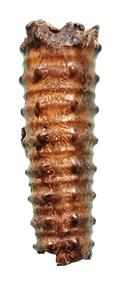
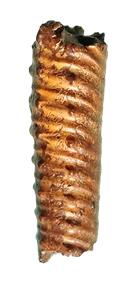
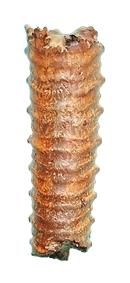
Description. A slightly curved shaft of a fully septate, pyritic internal mold with a circular section. The regular and delicate sculpture comprises 15 fine ribs, attenuated but distinct on dorsum, then convex and proverse on the flanks, and finally running straight across venter. These include strong ribs bearing two small, prominent and pimple-like ventral tubercles, and two slightly smaller lateral tubercles at mid-flank. These ribs alternate perfectly with finer ribs lacking tubercles. The interspaces between a fine rib and its two bordering ribs are often different. On the flank view, the ventral tubercles are on the left. The venter is flattened between ventral tubercles. Rib index is 5. The sutures show a second lateral lobe L2 and a trifid internal (dorsal) lobe. L1 is as large as the ventral lobe L, and both are bifid.
Remarques. Personal discovery. Species defined as Hamites moreanum by Buvignier (1852, atlas, p. 45 and pl. 31, fig. 15-19), based on a single specimen from Revigny-sur-Ornain (Meuse). It was described in more detail by Spath (1939, pp. 570-572). CP-656 closely resembles Buvignier's specimen and the Swiss specimens from Sainte-Croix, illustrated by Pictet & Campiche (1861, p. 81 and pl. 53, fig. 1-12). We have not found a published specimen with measurements. P. (P.) raulinianum (d'Orbigny, 1842) is a very similar species, but with coarser ornamentation, less oblique ribs on the flanks, blunter tubercles, and an irregular alternation of tuberculate and simple ribs. The P. moreanum in Jaffré (2007, p. 40-41) has very irregular ribs with 0 to 3 simple ribs between two tuberculate ones: it does not resemble the specimens of Buvignier and Pictet & Campiche and seems closer to P. (P.) raulinianum.