| Measurements | L | D | H/D | T/D | O/D | H/T |
|---|---|---|---|---|---|---|
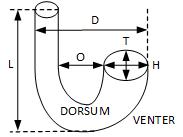
| CP-640 | 18.9 | 25.9 | 0.34 | 0.29 | 0.48 | 1.16 |
| Age | Origine |
|---|---|
|
Grey clay, subhilli zone Lower Albian |
Mesnil-Saint-Père Aube, France |
| Measurements | L | D | H/D | T/D | O/D | H/T |
|---|---|---|---|---|---|---|
| CP-640 | 18.9 | 25.9 | 0.34 | 0.29 | 0.48 | 1.16 |
| Age | Origine |
|---|---|
|
Grey clay, subhilli zone Lower Albian |
Mesnil-Saint-Père Aube, France |
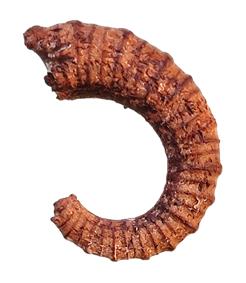
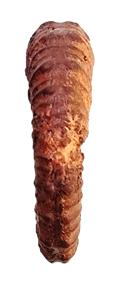
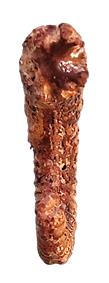
Description. Septate pyritic fragment with a slightly helical coil (see the bottom of the dorsal view on the right), probably the end of initial spiral. Compressed elliptical section with flattened sides, growing fairly rapidly in height. There are 34 simple, thin, slightly proverse ribs, indistinct on the dorsum. They are regularly spaced, with wider gaps between them. Some of them, stronger, bear two closely spaced ventrolateral tubercles, shaped like small, protruding pimples. They are flattened and widened between the tubercles. There is a single thin rib without tubercles between these tuberculate ribs, then two at the end of the shell. The rib index is 4. No trace of lateral tubercles. The ventral lobe and first lateral lobe are broad and bifid, the second lateral lobe is small and trifid, and the dorsal lobe is bifid.
Remarques. Personal discovery. P. (H.) flexuosum, P. (H.) nodosum (J. Sowerby, 1818), and P. (P.) coptense Casey, 1961 are the only Protanisoceras species that are compressed and lack lateral tubercles. The second has more intermediate ribs (2 or 3, then 4), a more helical spiral, and larger but blunt tubercles. The third has 3 intermediate ribs. According to Spath (1939, p. 590), P. (H.) flexuosum mimics Idiohamites spinulosus. It also resembles the Idiohamites spiniger of Hadland (2018, p. 89). But it comes from the subhilli zone (Lower Albian), while Idiohamites is from the Upper Albian. Besides England and France, it is found in Austria (Föllmi, 1989), Poland (Marcinowski & Wiedmann, 1990) and the Balearic Islands (Rullán, 1966). We have two little reservations about the identification. D'Orbigny's drawing shows more inclined ribs on the flanks. Furthermore, Spath (1939) states that the two known English specimens come from the dentatus zone (Middle Albian). But the latter difference is not critical, since too few specimens have been collected to know the exact vertical extension.