| Measurements | L | D | H/D | T/D | O/D | H/T |
|---|---|---|---|---|---|---|
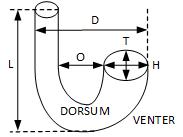
| CP-644 | 25 | 36.8 | 0.28 | 0.34 | 0.56 | 0.82 |
| Age | Origin |
|---|---|
|
Grey clay, subhilli zone Lower Albian |
Mesnil-Saint-Père Aube, France |
| Measurements | L | D | H/D | T/D | O/D | H/T |
|---|---|---|---|---|---|---|
| CP-644 | 25 | 36.8 | 0.28 | 0.34 | 0.56 | 0.82 |
| Age | Origin |
|---|---|
|
Grey clay, subhilli zone Lower Albian |
Mesnil-Saint-Père Aube, France |
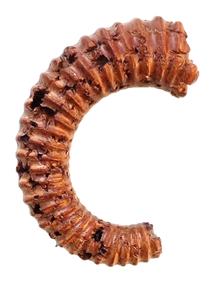
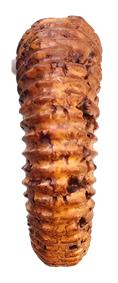
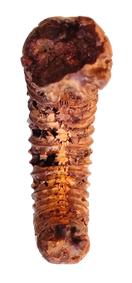
Description. Septate pyritic fragment, probably the end of the initial spiral. The section coiled in one plane is elliptical, moderately depressed, with a flattened venter and dorsum. 29 simple and strong ribs, quite sharp, regularly spaced, with wider intercostal spaces. On the dorsum, they are lower and thinner but very clear. The ribs are radial, except on dorsum where they form a weak convex sinus. They all have a small ventrolateral tubercle on each side of the siphon, often reduced to a simple angulation of the rib, visible in raking light. Absence of lateral tubercles. The rib index is 5. Under a magnifying glass, the sutures show that the ventral lobe, first lateral lobe, and small dorsal lobe are all symmetrical and bifid.
Remarks. Personal discovery. Differs fromP. (P.) cantianum by a smaller size, the absence of lateral tubercles, still clear ribs on the venter, the 1st lateral lobe and the dorsal symmetrical and bifid (resp. very asymmetrical and trifid in cantianum) and tubercles disappearing with age, which simulates a Hamites. The small tubercles reduced to angulations of the ribs are clearly visible on the pl. XLVII, fig. 1-10 of Pictet & Campiche (1861). According to Casey (1961, p. 104-105), theP. (P.) cantianum from Spath (1939, p. 567, fig. h-j) are blancheti specimens. The suture differences are clear in figs. c and k of Spath, redrawn by Casey (1961, text-fig. 36, p. 112). According to Destombes in Rat et al. (1979, p. 116), P. (P.) blancheti and vaucherianum are the most frequent heteromorph ammonites in the subhilli zone of Aube. The latter has stronger tubercles, persisting longer but irregularly distributed (with 1 or 2 simple ribs between 2 tuberculates, sometimes 0 or 3) and a trifid dorsal lobe.