| Measurements | L mm | H mm | T mm | H/T |
|---|---|---|---|---|
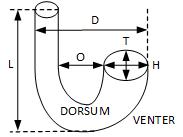
| CP-657 | 31.6 | 10.5 | 10.6 | 0.99 |
| Age | Origin |
|---|---|
|
Grey clay, dentatus zone Middle Albian |
Brévonnes Aube, France |
| Measurements | L mm | H mm | T mm | H/T |
|---|---|---|---|---|
| CP-657 | 31.6 | 10.5 | 10.6 | 0.99 |
| Age | Origin |
|---|---|
|
Grey clay, dentatus zone Middle Albian |
Brévonnes Aube, France |
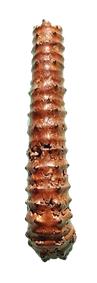
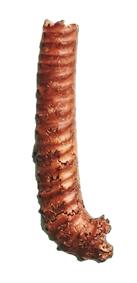
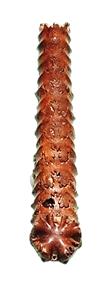
Description. Fully septate internal mold in pyrite, with a straight shaft and the beginning of the cross at the bottom. The section is circular between the ribs, the outer half in a half-hexagon at the level of the tubercles. 21 ribs with irregular spaces, slightly proverse and convex on the flanks, with a concave ventral sinus. 13 stronger ribs carry two small prominent ventrolateral tubercles, and two lower lateral ones at mid-flank. The other ribs are less strong and without tubercles. In general, two successive strong ribs are separated by a thin one, but three successive strong ribs are noted at the bottom of the ventral view. The rib index is 4. The second lateral lobe L2 and the dorsal lobe are trifid, the other lobes are bifid.
Remarks. Personal discovery. Species defined by an alternation of tuberculate and simple ribs, hence its name (sometimes written alterno-tuberculatum, with a hyphen), but Leymerie's drawing is idealized: in practice, we sometimes see 0 or 2 simple ribs between two tuberculates. Known specimens are small. The body chamber after the cross is parallel to the shaft and close to it, like on a saxophone. Without justification, Matrion (2010) places it in subgenus Protanisoceras, while Young et al. (2010) makes it a Heteroclinus. LikeP. (P.) moreanum (see its file), this species is known in Aube in the benettianus and dentatus zones. P. (P.) raulinianum(d'Orbigny, 1842) is a very similar species, but with stronger tuberculate ribs, irregularly separated by 0 to 3 simple ribs. It is tempting to think that the two forms are conspecific, but according to Matrion (2010),P. (P.) raulinianum is older in Aube: floridum and puzosianus zones.