Created 2023/09/02
Updated 2025/03/04
Prolyelliceras mathewsi (Knechtel, 1947)
| Measurements |
D mm | H/D | T/D | O/D | H/T |
|---|
| Robert 2002 |
57 | 0.32 | 0.26 | ? | 1.20 |
| CP-280 |
66 | 0.36 | 0.33 | 0.40 | 1.12 |
| CP-37 |
74.9 | 0.35 | 0.29 | 0.38 | 1.22 |
| Holotype1 |
102 | 0.37 | ? | 0.40 | ? |
1 Measured on the photo in Knechtel et al. (1947).
| Age |
Origin |
|---|
Black shale (anoxic facies)
mathewsi Peruvian zone
End of Lower Albian
|
Cerro Yanarajo
13 km ENE Huallanca
Ancash Region, Peru
|
Description.
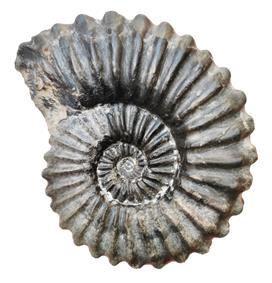
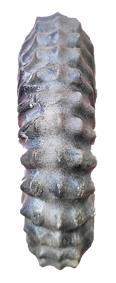
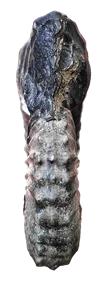
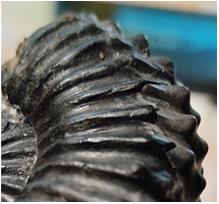
Nice internal mold in black shale without sutures, with the body chamber on 160°. Whorls 15% covered, with a compressed rectangular section, truncated upper corners, and flanks slightly converging toward a flattened venter. Wide umbilicus with a low, quarter-circle wall. 30 simple, straight, slightly proverse ribs with wider spaces originate on the umbilical wall and cross the flanks and venter. They bear siphonal and ventrolateral clavi of equal strength. Small lateral tubercles (photo) arise at the outer third of the flanks on the last half-whorl, at about 5 cm. Above them, the ribs widen and sag, giving interspaces almost as wide as the ribs on venter. They strengthen and get closer on body chamber. The ribs between 2 and 5h on the lateral view show fleeting traces of umbilical tubercles, not present on the other side.
Remarks.
Zone ammonite for the end of Lower Albian in Peru, below the P. ulrichi zone beginning Middle Albian (Robert, 2002).
Black ammonites from Peru are often misidentified in shows and online. Some are labeled Lyelliceras lyelli, though they lack umbilical tubercles. CP-37 was sold as a P. ulrichi, but the latter (see its entry) is thicker, with lateral tubercles appearing around 18 mm, vs 50 mm in P. mathewsi. For more data on the Andean Cretaceous, see Bürgl (1957), Etayo-Serna (1979), Riedel (1938) and Sharikadze et al. (2004) for Colombia, Renz (1982) for Venezuela, and Benavides-Cáceres (1956), Douvillé (1906), Knechtel et al. (1947) and Robert (2002) for Peru.