| Measurements | D mm | H/D | T/D | O/D | H/T |
|---|---|---|---|---|---|
| CP-345 | 25.3 | 0.41 | 0.35 | 0.32 | 1.17 |
| Holotype | 43.0 | 0.42 | 0.32 | 0.27 | 1.31 |
| Age | Origin |
|---|---|
|
Grey clay quarry schrammeni zone Basal Albian |
Vöhrum Lower Saxony Germany |
| Measurements | D mm | H/D | T/D | O/D | H/T |
|---|---|---|---|---|---|
| CP-345 | 25.3 | 0.41 | 0.35 | 0.32 | 1.17 |
| Holotype | 43.0 | 0.42 | 0.32 | 0.27 | 1.31 |
| Age | Origin |
|---|---|
|
Grey clay quarry schrammeni zone Basal Albian |
Vöhrum Lower Saxony Germany |
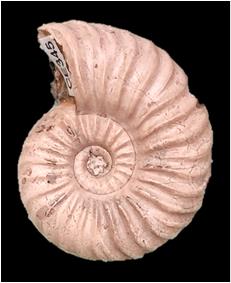
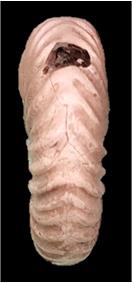
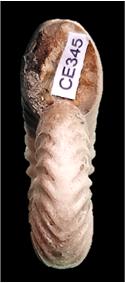
Description. A small but beautiful ammonite in black phosphate under a pearly test. The whorls overlap by one-third. Their cross-section is moderately compressed, elliptical, with slightly flattened flanks and a broadly rounded venter. The prominent primary ribs arise slightly below the umbilical margin but do not extend down the wall. On the inner whorls and at the beginning of last whorl, they are convex on the flanks. Then they become slightly proverse and somewhat flexuous. In the upper half of the flanks, some ribs divide into two closely spaced branches. A few secondary ribs arise below mid-flank. In total, one counts 28 ribs at the top of the flanks, somewhat irregularly spaced and strongly projected forward on ventrolateral shoulders. At the very beginning of last whorl, the ribs fade onto the shoulders of the venter, which is smooth over the siphon. Then they cross the venter, forming a strong, angular sinus directed forward. No tubercles are observed. no constrictions. The suture lines are invisible.
Remarks. This ammonite, known only from Germany, tends to become more compressed with age. The auxiliary elements of its suture have a curious feature: they form an alignment that advances towards the mouth (Jacob, 1907). Owen (1979) proposed its appearance to define the base of Albian at Vöhrum. Brinkmann (1937) defined an early variant, Proleymeriella schrammeni anterior, which retains a few constrictions of its Aptian ancestor, Callizoniceras. Mutterlose et al. (2003) show that this variant disappears when the true schrammeni (without constrictions) appear. They prefer to consider the appearance of the variant to define the base of Albian, as it coincides with a volcanic tuff layer that is easily traced in the field.