Created 2023/05/19
Updated 2025/10/11
Otohoplites subhilli (Spath, 1942)
| Measurements |
D mm | H/D | T/D | O/D | H/T |
|---|
| CP-128 | 35,3 | 0,37 | 0,33 | 0,33 | 1,13 |
| CP-350 | 42 | 0,46 | 0,35 | 0,26 | 1,32 |
| CP-176 | 56,2 | 0,40 | 0,33 | 0,28 | 1,20 |
| Age |
Origin |
|---|
Blue-grey clay
O. subhilli zone
Lower Albian
|
Buli, Pays de Bray
Seine-Maritime
France
|
Description.
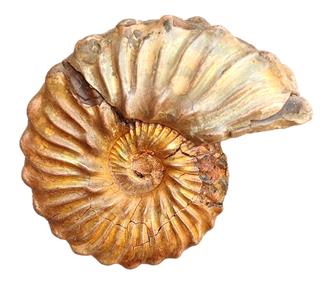
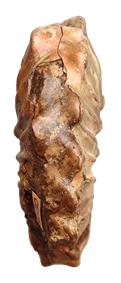
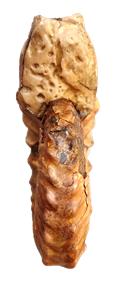
Beautiful pyritic specimen owned since 2005, suffering from inexorable decay despite treatment with ethanolamine thioglycolate. The pearly test hides the sutures. Whorls with a compressed trapezoidal cross-section, more convergent in the outer third of flanks, overlapping by 40%. Umbilicus with a low wall sloping at 50%. 15 radially pinched and proverse umbilical bullae arise from the umbilical edge. Each gives a pair of sigmoid ribs, thin but prominent, curved forward at the top of flanks where they meet on a strong ventrolateral clavus, parallel to the siphon and slightly inclined outwards. There are a total of 24 clavi, alternating on either side of the siphon. Sometimes their bases spread out and meet on the flat ventral surface, forming a zigzag line. A few shorter ribs are also present.
Remarks.
Spath (1942, p. 689) designated as the type species the Hoplites teuthydis from Mangystau, illustrated by Sinzow (1909, pl. 3, figs. 19-20), but it has disappeared from the collections of the Karpinsky Institute in Saint Petersburg. The species reaches 90 mm and defines a zone of Lower Albian. It is recognizable by its lautiform ribs and strong ventrolateral clavi parallel to the siphonal line. However, it is highly variable; see the measurements of the two non-nacreous pyritic specimens from Aube that we have added to the table (nos. 128 and 350) and the thick form in plate XII, fig. 11 of Amédro et al. (2014). O. subhilli is found in the Paris Basin, Northern Germany, Switzerland, Russia, and Kazakhstan, but not in England. It was Owen (1988) who showed that O. bulliensis Destombes, 1973 (a name better known in France) and O. venustus Saveliev, 1973, are in fact junior synonyms. According to Amédro et al. (2014), O. destombesi Casey, 1965, is a thick variant with strong and fewer ribs.