Created 2023/05/18
Updated 2024/03/31
Otohoplites raulinianus (d'Orbigny, 1841)
| Measurements |
D mm | H/D | T/D | O/D | H/T |
|---|
| CP-654 | 34.8 | 0.39 | 0.51 | 0.37 | 0.75 |
| CP-435 | 47.2 | 0.42 | 0.46 | 0.29 | 0.92 |
| Lectotype d'Orbigny | 70 | 0.43 | 0.40 | 0.30 | 1.07 |
| Age |
Origin |
|---|
Blue-grey clay
P. (H.) puzosianus zone
Lower Albian
|
Pays de Bray
Seine-Maritime
France
|
Description.
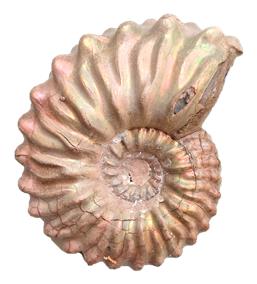
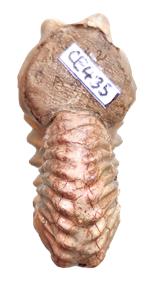
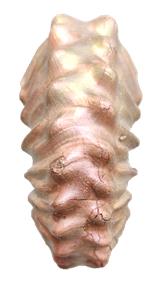
A magnificent specimen in gray phosphate, its pearly test concealing the suture lines. The thick, slightly depressed hexagonal whorls overlap by 50%. The rather broad umbilicus has a high wall sloping at 45°, which transitions to the flank via a rounded edge. The slightly convex flanks converge strongly towards a broad, flattened venter. Sixteen triangular tubercles arise very low on the umbilicus wall and give rise to pairs of ribs connected in loops or zigzags to 24 ventrolateral tubercles, oblique and alternate with respect to the siphonal line. These latter are blunt cones, somewhat pinched and inclined outwards, but far from being as compressed as the true clavi of Otohoplites subhilli. They are loosely connected by sagged bridges that form a zigzag line on venter. There are a total of 35 ribs, including 4 pairs of lautiform ones.
Remarks.
No, it's not an ammonite from Bully! The predominantly zigzag ribs are typical of this species. Less common than other Otohoplites, it is found in the puzosianus zone of the Anglo-Paris Basin and in Transcaspia (Mangystau). The three specimens in the table and those of Casey (1965) show that the H/T ratio is highly variable, from 0.75 to 1.07, but the majority of specimens are somewhat depressed. We saw in the genus entry that Amédro et al. (2014) place this species, along with O. subchloris Casey, 1965, in group 2. According to Casey's description and specimens, the latter is more or less compressed, has more lautiform pairs, and its ornamentation weakens as from 50 mm in diameter.