| Measurements | Cone mm | D | H/D | Ribs |
|---|---|---|---|---|
| CP-71 | 55.8 | 35.1 | 0.56 | 27 |
| Age | Origin |
|---|---|
|
Condensed level, fallax- inflatum-briacensis zones Upper Albian |
Monte-Carlo railway tunnel, Beausoleil Var, France |
| Measurements | Cone mm | D | H/D | Ribs |
|---|---|---|---|---|
| CP-71 | 55.8 | 35.1 | 0.56 | 27 |
| Age | Origin |
|---|---|
|
Condensed level, fallax- inflatum-briacensis zones Upper Albian |
Monte-Carlo railway tunnel, Beausoleil Var, France |
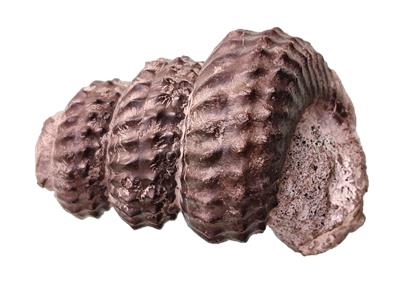
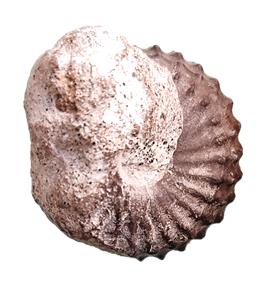
Description. Three contiguous whorls of a turricone internal mold in black phosphate, embedded in a glauconitic sandstone matrix. The apex is missing, and the aperture and umbilicus are not prepared. The whorls have an octagonal section with rounded corners. The beginning of the body chamber occupies the last whorl. The angle of the coiling cone (the apical angle) is 35°. If the apex is placed at the top, the first two whorls show three spiral rows of closely spaced tubercles, borne by oblique ribs. All these rows have the same number of tubercles. The uppermost tubercles (row 1) are elongated upwards along their rib. Those in the following rows are punctiform and offset towards the aperture relative to the preceding row. A fourth row is hidden by the suture between successive whorls, giving it a crenellated appearance. However, it is clearly visible beneath the last whorl. The space between rows 1 and 2 is slightly larger than that between rows 2-3 and 3-4. There are 27 ribs per whorl. They are distinct above row 1, attenuated between rows 2-3 and 3-4 (giving the impression of two spiral grooves), distinct again below row 4, and then gradually weaken towards the umbilicus.
Remarques. The apical angle varies between 33 and 38° (Spath, 1937). Jattiot et al. (2021) found two forms among numerous Mariella from Salazac (Gard): M. (M.) bergeri with 19–30 ribs per whorl (25 on average), and M. (M.) miliaris (Pictet & Campiche, 1861) with 33–40 ribs and smaller tubercles. There were no specimens with 31–32 ribs. This statistical separation justifies the second species, which was sometimes considered a variant. However, the study showed that the variety crassicostata of M. (M.) bergeri, created by Spath (1937) and elevated to species rank by Renz (1968), is indeed a robust variant, with 19–20 ribs bearing larger tubercles. Our ammonite is typical of the Vraconian, a stage that encompasses the last three zones of the Albian (fallax, inflatum, and briacensis).