| Measurements | D mm | H/D | T/D | O/D | H/T |
|---|---|---|---|---|---|
| RJ-984 | 29 | 0.39 | 0.37 | 0.34 | 1.05 |
| Holotype | 52 | 0.30 | 0.28 | 0.44 | 1.07 |
| Age | Origin |
|---|---|
|
Grey clay steinmanni zone Lower Albian |
Pargny-sur-Saulx Marne France |
| Measurements | D mm | H/D | T/D | O/D | H/T |
|---|---|---|---|---|---|
| RJ-984 | 29 | 0.39 | 0.37 | 0.34 | 1.05 |
| Holotype | 52 | 0.30 | 0.28 | 0.44 | 1.07 |
| Age | Origin |
|---|---|
|
Grey clay steinmanni zone Lower Albian |
Pargny-sur-Saulx Marne France |
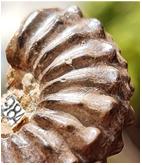
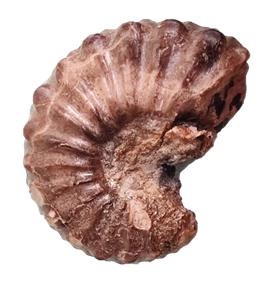
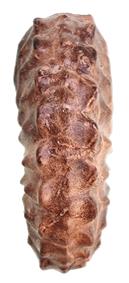
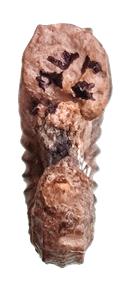
Description. Small, evolute specimen in brown phosphate, with 70% of the last whorl intact. The section is somewhat compressed, rectangular with truncated upper angles. The umbilical wall is rather low and rounded. On the last half-whorl, 12 alternate, simple, radial ribs widen from the umbilical suture to a strong clavus located at the edge of the flat venter. These ribs also bear a small, button-like umbilical tubercle and a lateral tubercle of the same shape, but stronger, at two thirds of the whorl, where the rectangular section is truncated. The last half-whorl also bears 19 small, closely spaced siphonal tubercles, pinched in the direction of the spiral. These tubercles are therefore more numerous than the lateral ones.
Remarks. The holotype ribs branch at the ventral clavus to join, attenuated, two siphonal clavi. These secondary ribs are indistinct on RJ-984. According to Amédro et al. (2014), this rare species comes from Tegoceras camatteanum (d'Orbigny, 1841), which has a rectangular section and a siphonal keel with undulations instead of clavi. Its alternate ribs bear a small umbilical tubercle, a lateral one at mid-flank, and a clavus on the edge of the flat venter. The appearance of a distinct umbilical tubercle and siphonal tubercles, more numerous than the ventrolateral ones, leads to L. vaasti. The venter rounds and the lateral tubercle moves near the ventrolateral one, resulting in L. pseudolyelli. Finally, the ribs become opposite and cross venter to form L. lyelli. RJ-984 begins the transition to L. pseudolyelli, as its lateral tubercles are already positioned quite high on the flanks. However, it still has a flat venter.