Created 2023/08/26
Updated 2023/09/23
Lyelliceras pseudolyelli (Parona & Bonarelli, 1897)
| Measurements |
D mm | H/D | T/D | O/D | H/T |
|---|
| CP-92 |
23.2 | 0.37 | 0.45 | 0.34 | 0.82 |
| Kennedy & Klinger 2008a |
37 | 0.42 | 0.40 | 0.36 | 1.05 |
| Lectotype |
43 | 0.35 | 0.35 | 0.37 | 1.00 |
| Kennedy & Klinger 2008a |
64.3 | 0.30 | 0.33 | 0.49 | 0.92 |
| Age |
Origin |
|---|
Grey clay, lyelli subzone
benettianus zone, Middle Albian
|
Géraudot
Aube, France
|
Description.
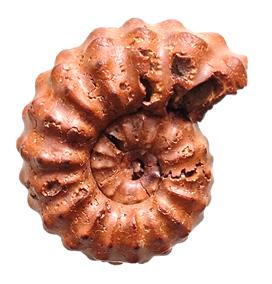
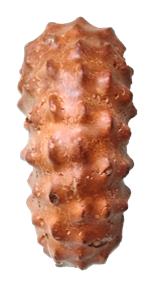
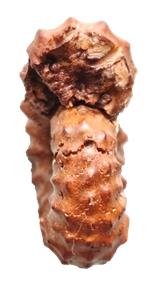
A small, pyritic phragmocone with visible sutures, its whorls covered by 15% have a slightly depressed, reniform section. 17 strong ribs arise from the umbilical wall. They are alternate on each side of the venter, slightly rursiradiate, initially slightly convex and then somewhat concave at the end of the shell, with interspaces as wide. Each rib bears on its flank a pimple-like umbilical tubercle, a similar lateral tubercle, and a stronger ventrolateral tubercle pinched in the direction of coiling (a clavus). The siphonal line is occupied by 23 clavi, slightly smaller than the ventrolateral ones. Most of the ribs bifurcate at the ventrolateral clavus to join two siphonal, but some cross the venter without branching, giving the ribs an irregular zigzag appearance on the venter. The ribs are slightly sagged between the ventrolateral and siphonal clavi. The wide umbilicus has a fairly low wall, with a quarter-circle profile, and a suture which passes slightly above the lateral tubercles of the previous whorl.
Remarks.
Personal discovery. The umbilicus tends to open with age. Like L. lyelli, the proportions are quite variable; see the table. The sutures are identical. The ribs are sometimes opposite (Kennedy & Klinger, 2008a) or interrupted on venter (Latil, 1994), but the species can be recognized by more siphonal clavi than ventrolateral ones.
L. hirsutum (Parona & Bonarelli) is a variant with stronger and fewer ribs (about a dozen).
In Amédro's phyletic zonation (1992), L. pseudolyelli defines a subzone for the lower half of the benettianus zone, with the other half corresponding to the lyelli subzone. This subzone that indicate the end of Lower Albian extends from the extinction of Isohoplites steinmanni to the appearance of L. lyelli. In fact, rare specimens are still found at the base of the lyelli subzone.