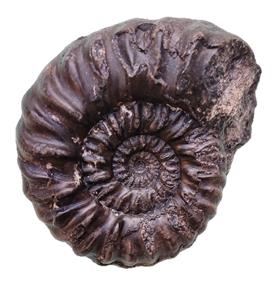
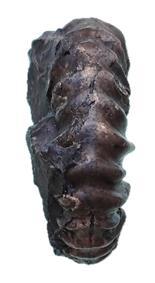
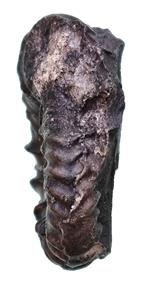
Hysteroceras aff. varicosum (J. de C. Sowerby, 1824)
| Measurements |
D mm | H/D | T/D | O/D | H/T |
|---|
| Holotype |
39 | 0.36 | 0.32 | 0.38 | 1.12 |
| Stieler 1920* |
47 | 0.36 | 0.38 | 0.43 | 0.95 |
| CP-667 |
55.8 | 0.32 | 0.33 | 0.45 | 0.97 |
* var.
binodosa with a widened periphery.
| Age |
Origin |
|---|
Anoxic facies, Peruvian
equivalent of pricei zone?
Upper Albian
|
Quebrada Geshgash, 10 km
SSE La Oroya, Yauli Province
Junin Region, Peru
|
Description.
Specimen in bituminous limestone without visible sutures, with one face not prepared. The spire is highly evolute with whorls of squarish section, 20% covered. The umbilicus is very wide, with a rounded wall. The inner whorls show thin ribs arising in pairs from a small umbilical bulla. The last two whorls show an alternance of long and short ribs. Long ribs (15 on last whorl) arise abruptly from the umbilical wall and form prominent tubercles on its margin. They lower along the flanks, with a straight ridge. Short ribs appear below mid-flank but are then similar to the long ones. One counts 28 ribs on the upper flanks, curved forward, with wider spaces.
At the beginning of last whorl, the ribs remain quite thin on venter but form an angular chevron of 120°. Next, they swell on the ventrolateral shoulders, sag slightly on the siphonal line, while the ventral chevron opens and rounds. Rather than a keel, there is a fold along the siphonal line, mainly visible between the ribs, giving a subtly fastigiate venter.
Remarks.
Resembles Spath's specimens, especially the one in his text-fig. 102 b-c for the number of ribs. However, the intercostal spaces of CP-667 are wider, the ventral chevron is stronger, and the ribs bulge rather late, hence the affinis identification. A new species is not excluded.
This is an exceptional specimen among the Peruvian ammonites seen on the web and at fossil shows. The Upper Albian is only proven in a few places in Peru, with Hysteroceras aff. varicosum and unspecified Dipoloceras (Robert, 2002). Since these layers are very sparsely fossiliferous compared to the Lower and Middle Albian, no zonation exists. We can only say that these levels correspond to the cristatum and pricei zones of the Anglo-Paris Basin, that is to say, to the bottom of the upper Albian.