| Measurements | D mm | H/D | T/D | O/D | H/T |
|---|---|---|---|---|---|
| RJ-367 | 27.7 | 0.34 | 0.41 | 0.43 | 0.82 |
| Age | Origin |
|---|---|
|
Phosphatic-glauconitic sand cristatum to inflatum zones Upper Albian condensed level |
Disused phosphate mine Valserhône (ex-Bellegarde) Ain, France |
| Measurements | D mm | H/D | T/D | O/D | H/T |
|---|---|---|---|---|---|
| RJ-367 | 27.7 | 0.34 | 0.41 | 0.43 | 0.82 |
| Age | Origin |
|---|---|
|
Phosphatic-glauconitic sand cristatum to inflatum zones Upper Albian condensed level |
Disused phosphate mine Valserhône (ex-Bellegarde) Ain, France |
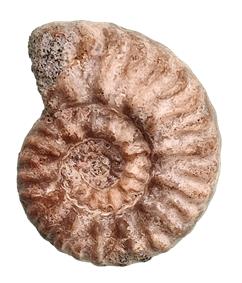
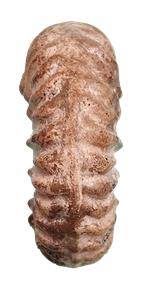
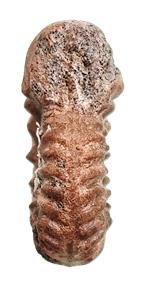
Description. Serpenticone ammonite in glauconitic sandstone, covered with a grayish phosphate test, without visible sutures. The whorls overlap by barely 10%. Trapezoidal whorl section, a bit depressed, with broadly rounded ventral shoulders and a slightly convex venter. Very wide umbilicus, with a low wall sloping at 70° that rounds towards the flank. 14 broad but widely spaced primary ribs arise at the umbilical suture. They are proverse on the umbilical wall, then form a small, raised, pinched bulla on its edge, where they divide into two flexuous, retroverse secondary ribs. The ribs increase in height and width towards the venter, which they cross in forming an obtuse 140° chevron. A thin siphonal keel crosses the ribs and their intervals, which are as wide. On the last half-turn, one of the secondary ribs from each bulla detaches to form an intercalary rib beginning at mid-flank. Simultaneously, the keel faints on the ribs but remains visible in the intercostal spaces. There are 28 ribs in total on venter.
Remarks. This species was initially placed in genus Brancoceras by Spath. The differences between the main species of Hysteroceras are explained on the page for this genus. H. orbignyi is often confused with H. varicosum, but the latter has fewer ribs, with more bulbous terminations. Since borderline specimens exist, the two forms may be extreme variants of the same species (Amédro, 1992).