Created 2023/04/23
Updated 2025/10/11
Hoplites (Isohoplites) steinmanni (Jacob, 1907)
| Measurements |
D mm | H/D | T/D | O/D | H/T |
|---|
| Holotype I. eodentatus | 43 | 0.39 | 0.30 | 0.28 | 1.31 |
| CP-434 | 48 | 0.40 | 0.35 | 0.28 | 1.12 |
| Holotype coll. Campiche | 67 | 0.42 | 0.30 | -- | 1.40 |
| Age |
Origin |
|---|
Blue-grey clay
H. (I.) steinmanni zone
Lower Albian
|
Pays de Bray
Seine-Maritime
France
|
Description.
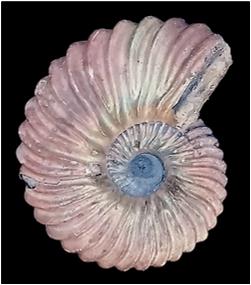
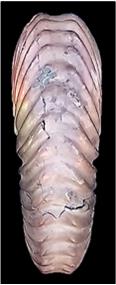
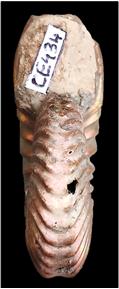
A fine specimen chambered over the last 120°, with a preserved pearly test. The slightly compressed whorls overlap by 40%. The umbilical wall, sloping at 60°, passes to the flank with a rounded edge. The slightly convex flanks are nearly parallel up to mid-flank, then converge towards a broad, flattened venter. 18 bullae originate very low on the umbilical wall. They are radially elongated, slightly proverse, and give rise to pairs of fine, prominent ribs that curve forward. At the beginning of last whorl, these ribs have slightly raised ventrolateral terminations, positioned opposite each other on either side of the siphon, thus delimiting a ventral groove. Then they become connected on venter by a bridge that gradually rises. Including a few intercalary ribs, there are a total of 35 ribs.
Remarks.
The ribs on the flanks are those of H. dentatus. Like the latter species, they are interrupted on the siphon but show opposite terminations. However, on the body chamber or sometimes earlier, they connect by crossing the venter. Some specimens even have alternate ribs, which gradually shift to become opposite and then connect. The table shows that the H/T ratio is quite variable: it is lower on CP-434 due to a widening of the section on the body chamber.
Saveliev (1976) and Owen (1988) place Isohoplites in the genus Pseudosonneratia, but Amédro (1992) shows that the subgenus is more recent, descending from the late Otohoplites O. normanniae. The species steinmanni is the only one in its subgenus: H. (I.) eodentatus Casey, 1961, is a junior synonym according to Amédro (1983). Besides the Anglo-Paris Basin, it is found in the Swiss Jura, the northern Alps, Svalbard (Norway), and Mangystau (Kazakhstan). It defines a Lower Albian ammonite zone.