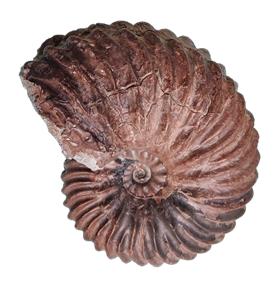
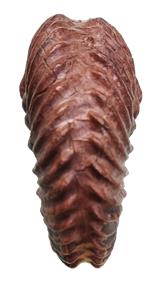
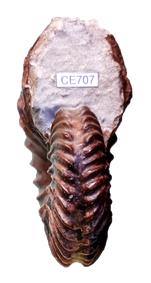
Hoplites (Hoplites) spathi – Second specimen
| Measurements |
D mm | H/D | T/D | O/D | H/T |
|---|
| CP-707 | 76.8 | 0.48 | 0.48 | 0.24 | 1.00 |
| RJ-565 | 91.1 | 0.45 | 0.49 | 0.25 | 0.92 |
| CP-257 | 139.5 | 0.45 | 0.44 | 0.28 | 1.02 |
| Age |
Origin |
|---|
Bed B, benettianus zone
lyelli subzone, Middle Albian
|
Courcelles
Aube, France
|
| Var. | dentatus | spathi | paronai |
|---|
| H/T | 1.21-1.27 | 0.92-1.02 | 0.67-0.83 |
| T/D | 0.37-0.40 | 0.49 | 0.52-0.70 |
Description and remarks.
First, read the entry for H. (H.) dentatus. This beautiful and very well-preserved specimen, with its body chamber on the last half-whorl, is typical of Courcelles. In the last table, it corresponds to the spathi variant of H. dentatus, given its wide, straight groove and its whorl section as tall as wide. Compared to CP-257 and RJ-565, on the body chamber, the top of the flanks is more rounded and the umbilicus has a wider edge, giving a less hexagonal, rather elliptical whorl section. Its ornamentation is also denser: there are a total of 16 umbilical tubercles and 38 ribs on the last whorl.
According to Amédro (1992), it is this variability, with all possible intermediate forms, that justifies reclassifying the Spath species H. paronai and H. spathi as mere variants of H. dentatus, which predates them.
The ammonite was extracted from a calcareous nodule of bed B, which marks the end of the benettianus zone. This bed already contains a few H. dentatus, but they are in the minority. Indeed, in Amédro's (1992) phylogenetic zonation, the dentatus zone is a partial range zone, the beginning of which corresponds to the disappearance of H. benettianus, and not to the appearance of H. dentatus.